



Irreverent Reviews
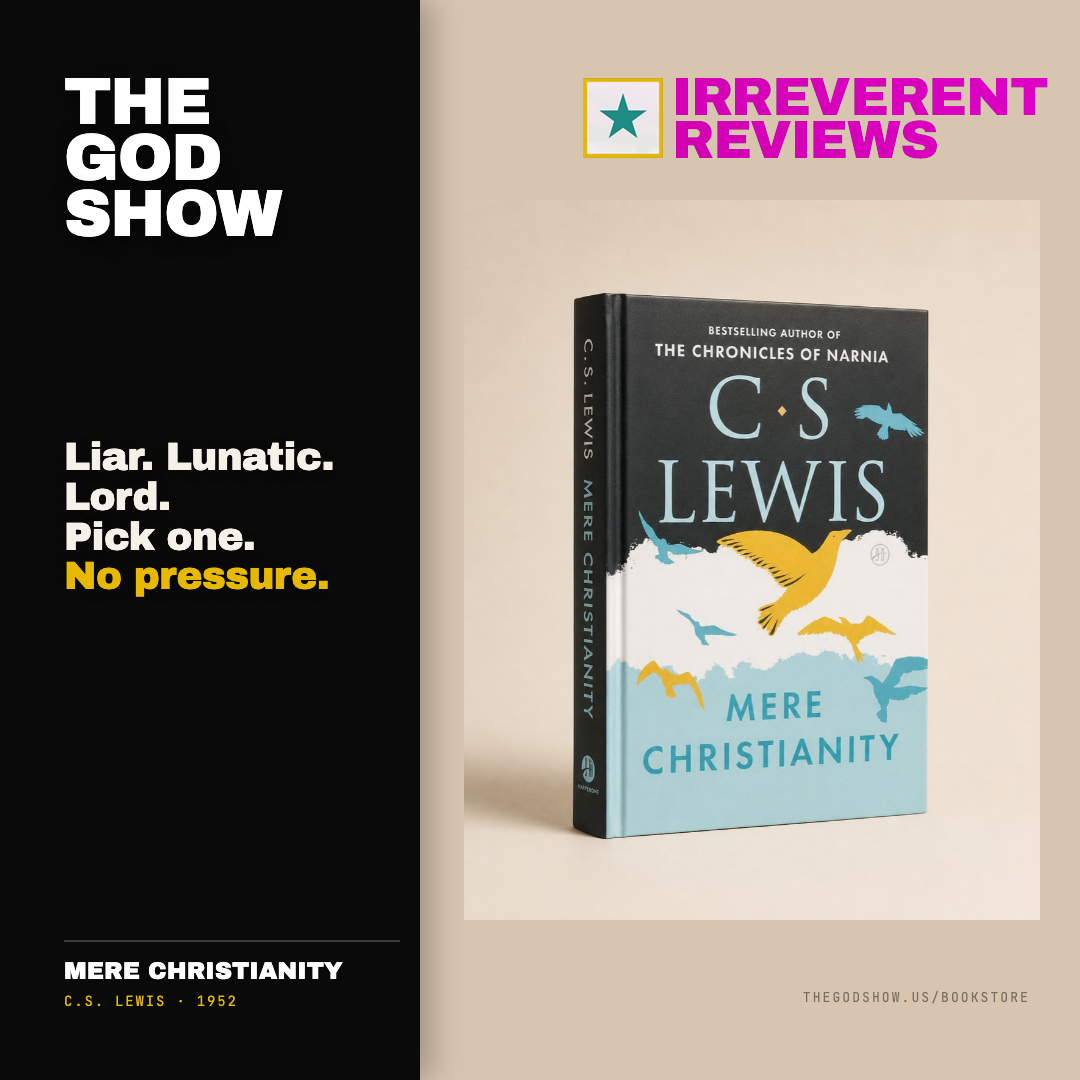
Mere Christianity
C.S. Lewis · 1952
The Blitz-era radio talks that became Christianity's smoothest sales funnel—cozy fireside logic from an Oxford don who had already tried atheism and quit.
Buy on Amazon →While the Luftwaffe was rearranging London, the BBC handed a microphone to a beer-drinking, chain-smoking Oxford medievalist and asked him to reassure a frightened nation in fifteen-minute installments. C.S. Lewis—First World War veteran, lapsed atheist argued back into faith partly by his friend Tolkien on a long night walk, a man who shared his house for decades with his dead war buddy's mother in an arrangement biographers still squint at—delivered the coziest crisis broadcasting ever aired. Stitched together in 1952 from three slim wartime volumes, the talks became Mere Christianity: the most effective recruiting pamphlet the faith has produced since Paul stopped sending letters.
Selling the Hallway, Not the Rooms
The 'mere' is the strategy. Borrowing the word from the Puritan Richard Baxter, Lewis refuses to litigate denominations: he is selling the hallway of common Christianity, and you can pick a room—Rome, Canterbury, Geneva—once you are inside the house. The pitch opens with the moral law: every playground quarrel, he observes, smuggles in a standard of fairness that nobody invented and everybody cites, and he argues the standard points beyond us. Professional philosophers have been writing irritated footnotes about this ever since—Lewis was a literature don doing metaphysics with a debater's footwork, and after Elizabeth Anscombe mauled one of his arguments at an Oxford club in 1948, legend says he retreated to Narnia. The legend is overcooked. The bruise was real.
Liar, Lunatic, or Loaded Question
Then the famous trilemma: Jesus claimed what he claimed, so he was a liar, a lunatic, or the Lord—and the one exit Lewis welds shut is the polite modern compromise, the 'great moral teacher.' It is the book's most quoted move and its most mugged. Critics keep pointing at the missing doors—legend, embellishment, misremembered sayings—and note that the trap only springs if you already treat the gospels as court transcripts. It converts people anyway, by the thousands. Rhetoric this clean doesn't need to be airtight—it needs to be quotable. In 2026 the trilemma still closes more deals than any seminary syllabus, which tells you less about logic than about how persuasion actually works.
Cocoa with a Body Count
The style is the secret weapon: fireside analogies—eggs that must hatch or go bad, a fleet of ships that must sail in formation, pride as the spiritual cancer—in prose that goes down like cocoa. The smoothness is the genius and the hazard, because you can swallow a whole metaphysic before noticing you were drinking. The chapter on pride remains one of the great self-recognition machines in English; it has ambushed everyone from Watergate felon Chuck Colson, who converted after reading it, to geneticist Francis Collins, who walked from atheism to running the Human Genome Project with this paperback in his coat. Doubting teenagers have been handed it at graduation ever since, like a fire extinguisher.
“Rhetoric this clean doesn't need to be airtight—it needs to be quotable.”
Verdict
Mere Christianity is salesmanship of the highest order, and pretending otherwise insults both the salesman and the product. Lewis knew exactly what he was doing: clear the rubble, light the fire, pour the cocoa, and let the wartime dark do the rest. Read it for the prose, for the pride chapter, and for the spectacle of a master closer working a room he cannot see. Whether you sign is between you and the hallway. Either way, raise a pint at the Eagle and Child—Jack is buying, and he will absolutely bring up your soul before last orders.