

















































Irreverent Reviews
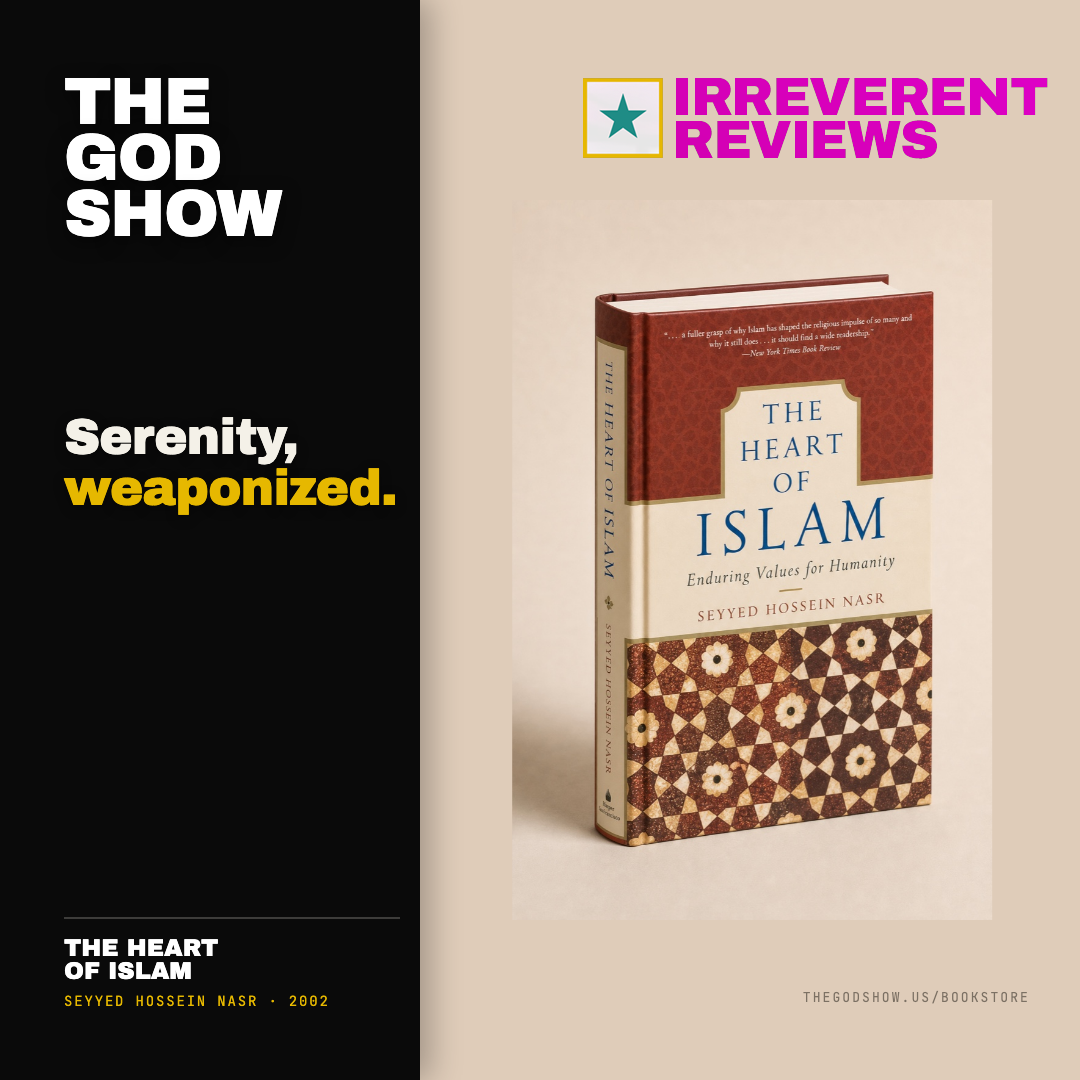
The Heart of Islam
Seyyed Hossein Nasr · 2002
Months after 9/11, America wanted a suspect sketch of Islam. The Shah's exiled court philosopher handed it a Persian miniature instead.
Buy on Amazon →Seyyed Hossein Nasr has lost more than most public intellectuals ever own. Born into Tehran's scholarly aristocracy, he went to MIT for physics, decided the discipline could not tell him what reality actually is, took a Harvard doctorate in the history of science instead, and built Iran's Imperial Academy of Philosophy under royal patronage—then watched the 1979 revolution vaporize his post, his library, and his country while he happened to be abroad. He rebuilt in American exile and became the first Muslim to deliver Scotland's storied Gifford Lectures. So when the towers fell and publishers went hunting for an explainer, they got a man constitutionally incapable of panic. The Heart of Islam, written in the smoke of late 2001, refuses the era's interrogation-room lighting and describes, with maddening calm, what more than a billion people are actually reaching for when they pray.
Answering a Fire with a Garden
While the explainer industry cranked out forensics—hijacker biographies, madrassa exposes—Nasr wrote ontology. One God; a chain of prophets Muslims honor from Abraham through Jesus; sharia not as horror-movie prop but as what the word means in Arabic, the path to water, a way of ordering a whole life toward the sacred; jihad as struggle, with the inner war against the ego ranked above any battlefield. He answers a five-alarm fire with a garden tour. It is a gorgeous garden—symmetrical, perfumed, planted over fourteen centuries—and he walks you through it as if no one outside were shouting. The serenity is the strategy: he is wagering that dignity, at sufficient altitude, reads as rebuttal.
The Catch
The catch: this is Islam as it should be, and Nasr mostly declines to audit Islam as it is. Sectarian blood, dynastic thuggery, the modern police states of the Muslim world—these appear chiefly as deviations from the ideal, the way a brochure for Venice omits the smell. Meanwhile his perennialism, the conviction that every authentic revelation climbs the same mountain, hums beneath the prose—which manages to infuriate Salafi literalists and New Atheists in identical ways, a rare diplomatic achievement. And he is nobody's house moderate: the book's contempt for Western consumer nihilism is as serene and total as its contempt for the bombers. In 2026, when every catastrophe gets a twelve-hour news cycle and a merch drop, there is something almost insubordinate about a man who answered the loudest month in American history at the speed of the eternal.
“He answers a five-alarm fire with a garden tour.”
Verdict
The Heart of Islam will not explain the geopolitics, and it never intended to; it explains the longing that the geopolitics keeps being mistaken for. Read it as a corrective, not a census. It pairs unexpectedly well with a newspaper: one page tells you what happened, the other what was betrayed. Then pour the tea, sit down in the garden, and let the exile describe the home no revolution could burn down—because he carries it. To the unburnable.