


















































Irreverent Reviews
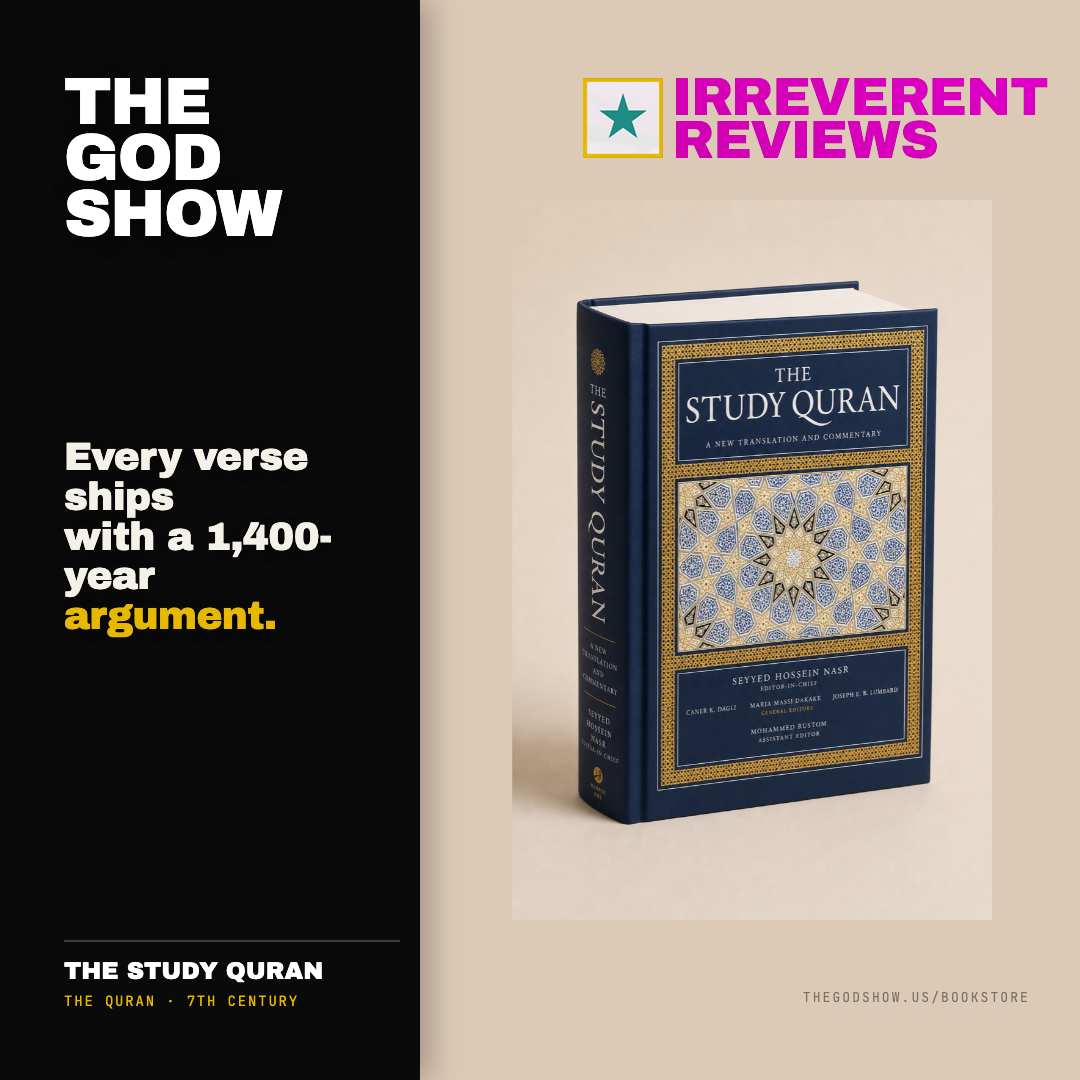
The Study Quran
The Quran · 7th century
HarperOne gives the Quran the deluxe-annotation treatment: nearly 2,000 pages in which forty-one classical commentators politely brawl beneath every verse.
Buy on Amazon →Start with the name: Quran means recitation. This is a seventh-century oral event—revealed over twenty-three years, memorized whole by schoolchildren, chanted in an Arabic so rhythmically dense the tradition declared it inimitable—and it has spent fourteen centuries being flattened into a book and skimmed by people hunting for ammunition. The Study Quran is the corrective. Seyyed Hossein Nasr, who agreed to edit only on condition that the entire team be Muslim, spent the better part of a decade with four younger scholars building a fresh translation wrapped in verse-by-verse commentary drawn from forty-one classical interpreters—Sunni and Shia, sober jurists and God-drunk mystics. The page itself is the argument: a thin ribbon of scripture afloat on an ocean of footnotes, like a Talmud spread that wandered in from Vilna.
A Recitation Held Hostage by Print
Read cover to cover like a novel, the Quran disorients on purpose. After the seven-verse opening prayer, the chapters run roughly longest to shortest, which means newcomers slam straight into al-Baqara—286 verses of law, covenant, and cosmic litigation—and conclude the book has no plot. It never wanted one. It is a recitation: circling, incantatory, built for the ear and the night vigil, not the hammock. The commentary here does what no bare translation can. It tells you what occasioned a verse, what was happening in Medina that week, why the Arabic pun cannot survive the trip into English. Every English Quran is a transcript of a thunderstorm. This one at least includes the weather report.
Heaven's Comments Section
The forty-one commentators are the show. Al-Tabari hoards every early opinion like a man who cannot delete an email; Fakhr al-Din al-Razi turns single verses into philosophy seminars; the Sufis read a battle as war against the ego while the jurists, two columns over, are still arguing contract law. The editors refuse to crown winners—they stack the disagreements in plain sight, a millennium of brilliant men interrupting each other beneath the text they all revere. Disagreement, it turns out, is not a crack in the tradition; it is the tradition. And when the page reaches the so-called sword verse, the cable-news reading gets quietly buried under treaty contexts, abrogation debates, and centuries of jurists insisting on restraint—scholarship doing what chyrons cannot.
The Beef in the Back Pages
Reception was its own comedy. Universities adopted it, HarperOne marketed it as the sibling of its house Study Bible, and a vocal squad of hardline critics declared it dangerous—not for anything it says about Islam, but because Nasr's perennialism, his conviction that every authentic revelation refracts one Light, keeps seeping through the notes like incense under a door. In 2026, when a pundit waves six words of scripture at a camera, this two-thousand-page rebuttal just sits on the shelf, patient as geology. The quiet thesis of the whole enterprise: anyone who tells you the Quran has exactly one meaning has not read the Muslims.
“Disagreement, it turns out, is not a crack in the tradition; it is the tradition.”
Verdict
You do not read The Study Quran; you move into it, the way you move into a neighborhood—slowly, verse by verse, learning which commentators throw the best arguments. It will not hand you a hot take, and that is the point: it answers the loudest book in geopolitics with the most patient apparatus in publishing. Take it with the drink this tradition gave the world—coffee, brewed by Yemeni Sufis to keep the night prayers burning—and raise the cup: to the book that answers every soundbite with fourteen centuries of footnotes.