























































Irreverent Reviews
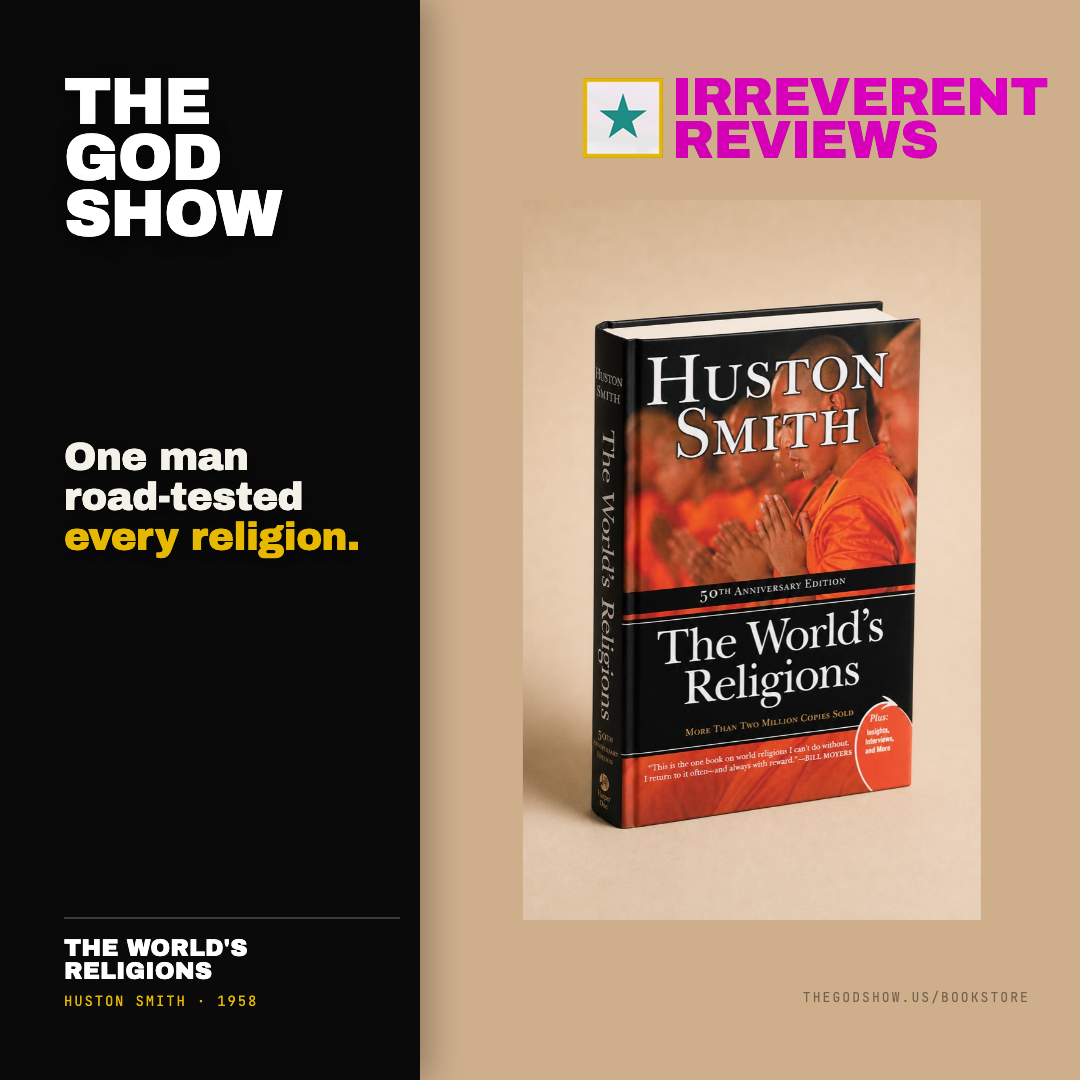
The World's Religions
Huston Smith · 1958
The missionary kid from China who meditated, whirled, prayed, and tripped through every major faith—then wrote the textbook three generations argued with.
Buy on Amazon →Huston Smith was born to Methodist missionaries in Suzhou, China, in 1919, which means America's great explainer of world religions spent his boyhood as the religious minority—useful training. The book began as a 1955 public-television series out of St. Louis, became The Religions of Man in 1958, got renamed and updated in 1991, and somewhere along the way sold two and a half million copies and colonized half the comparative-religion syllabi in America. Three generations can pronounce Upanishads because of this man.
Wine-Tasting, Not Autopsy
Smith announces his bias up front: this is the world's religions at their best—the clean upper floors, not the basement with the inquisitions. Hinduism arrives via its four yogas, Buddhism via the Eightfold Path, Confucius as the world's greatest theorist of social grace, Islam rendered with a warmth vanishingly rare in 1958 America, and—after the 1991 revision—the primal traditions finally get a chapter. He writes about every religion the way you'd describe a friend to someone you hope will love them. Critics call that airbrushing, and they are not wrong; Smith called it deliberate, on the theory that autopsies never made anyone love the patient.
He Ate the Whole Menu
The scandal and the charm of Smith is that he practiced what he surveyed—simultaneously. A decade of Vedanta in St. Louis. Koan training in Kyoto. Years of Muslim prayers, five a day, on schedule. All while remaining a churchgoing Methodist, on the logic that a home cuisine still benefits from supplements. He took mescaline with Timothy Leary's Harvard circle on New Year's Day 1961 and turned up in the famous Good Friday psilocybin experiment, filing entheogens under possibly authentic, definitely not a shortcut. In 1996 Bill Moyers gave him five hours of PBS prime time—a religion scholar as national television event, which now sounds like science fiction.
The Mountain Problem
The book's soul is perennialism: many paths, one summit, one Light refracting through every stained-glass window. It is generous, it is beautiful, and it is the single claim his successors most love to torch—Stephen Prothero wrote an entire book, shelved nearby, arguing the mountains are not even on the same continent. In 2026, with religious illiteracy still fueling conflicts the algorithms happily cater, both men look right: Smith about the reverence owed, Prothero about the differences ignored. Buy both. Argue over dinner. That argument is the education.
“He writes about every religion the way you'd describe a friend to someone you hope will love them.”
Verdict
Yes, it is dated; yes, it idealizes; yes, the prose occasionally smells of pipe smoke and seminar room. It is also the most loving single volume ever written about humanity's attempts at the sacred, by a man who did not so much study religions as marry into all of them. He died in 2016 at ninety-seven, presumably waved through every gate. Raise whatever your tradition pours—he would have tried it, twice, and taken notes.