







































Irreverent Reviews
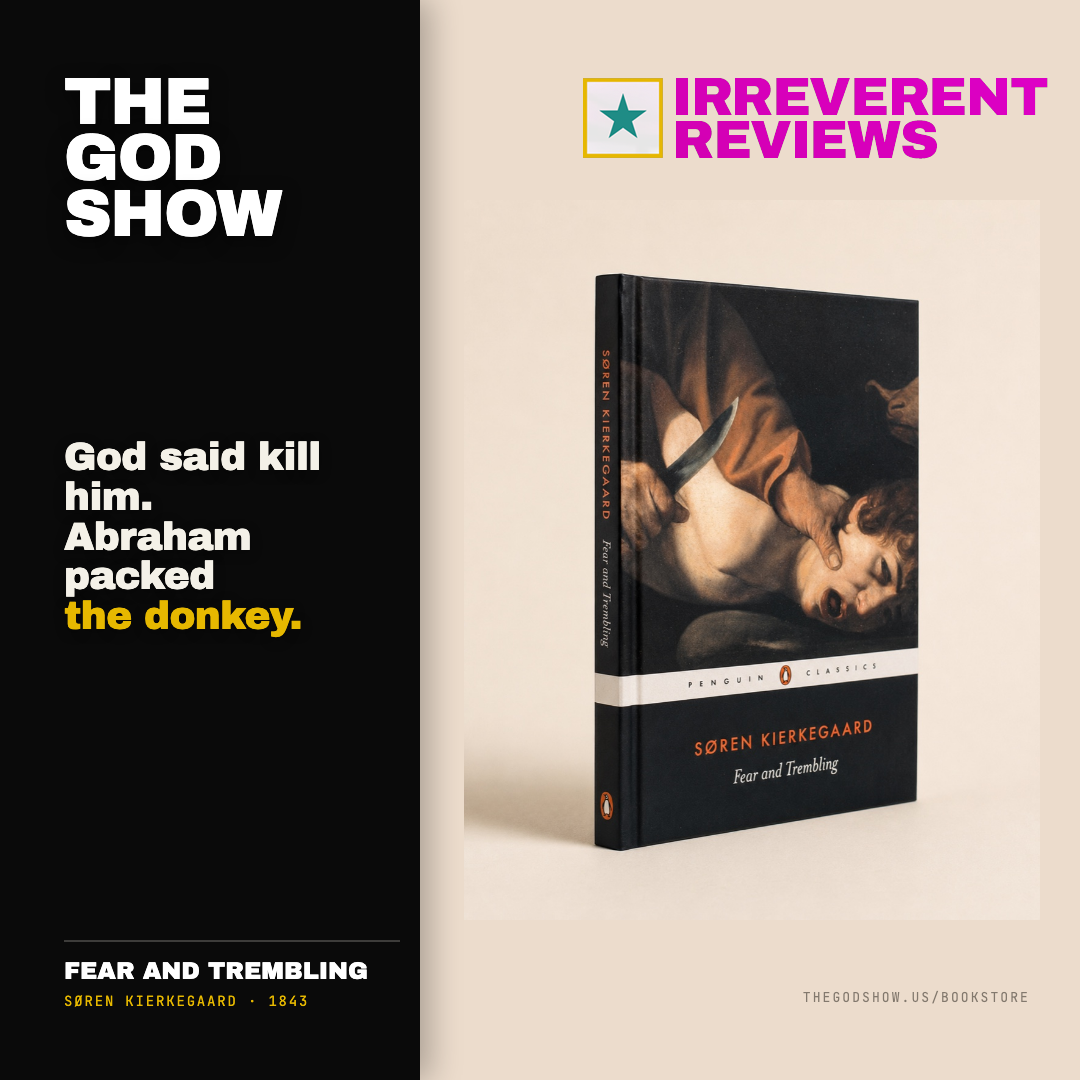
Fear and Trembling
Søren Kierkegaard · 1843
A jilted Dane stares at the Abraham story until it stops being Sunday school and becomes a horror film about what trusting God actually costs.
Buy on Amazon →Copenhagen, 1843. A thirty-year-old rich kid with a guilt complex the size of Jutland publishes a short book under the name Johannes de Silentio — John of Silence, an alias with a wink, since the whole thing is about what cannot be said. Two years earlier, Søren Kierkegaard had detonated his engagement to Regine Olsen for reasons he never adequately explained to her, to himself, or to the nineteenth century. Now he sits down with the story every Sunday school sands into a lesson about obedience — God orders Abraham to sacrifice Isaac — and refuses to let it be a lesson. He retells it until it becomes what it always was: a three-day donkey ride toward an unthinkable act, taken by a father who tells no one. Kierkegaard's project is to make faith expensive again.
Four Remixes and a Knife
The book opens with a man who has loved the Abraham story since childhood and understood it less every year, so Johannes runs the tape four different ways — in one, Abraham pretends to be a monster so Isaac will lose faith in his father rather than in God; in another, Abraham obeys but never recovers his joy. Each variation is humanly comprehensible, and each, Kierkegaard insists, falls short of what Genesis actually reports: that Abraham saddled the donkey early in the morning and went, without one word of protest, somehow still trusting he would keep Isaac. The slow motion is the point. Christendom had turned the rawest story in scripture into wallpaper; Kierkegaard peels it off with a fingernail.
Faith Looks Like a Guy Excited About Dinner
Then the conceptual machinery, the best he ever built. The knight of infinite resignation gives up what he loves and lives nobly inside the loss — that's Agamemnon, that's every renunciation we know how to admire. The knight of faith does something categorically weirder: gives it all up and simultaneously believes, on the strength of the absurd, that he'll get it back in this life. And from the outside, nothing shows — Kierkegaard's knight of faith looks like a plump burgher strolling home anticipating a hot roast, indistinguishable from a tax collector. No glow, no tragedy, no soundtrack. Abraham, meanwhile, gets the book's most notorious idea, the teleological suspension of the ethical: the possibility that a command from God can override the universal moral law — which is exactly the claim ethics cannot hear as anything but murder. Abraham can't explain himself, because explanation is ethics' native language. Hence the silence. Hence the trembling.
The Regine Subtweet
Reader, none of this is abstract. Kierkegaard had just sacrificed his own Isaac — Regine — and the book vibrates with the deranged hope that some movement of the absurd might hand her back. It didn't. She married a respectable civil servant; Kierkegaard willed her everything anyway. In his journals he predicted, with insufferable accuracy, that this little book alone would make his name immortal. In 2026, when faith is mostly marketed as a wellness feature — calmer mornings, longer lifespan, better sleep scores — his point lands harder than ever: anything that costs you nothing is not faith. It's a subscription.
“Kierkegaard's project is to make faith expensive again.”
Verdict
Fear and Trembling won't make you religious, and it has nothing but contempt for the version of religion that makes you comfortable. What it does is restore the scale of the question — what would it mean to trust something past every reason you could give — and then it abandons you on the mountain with the knife raised and no narrator coming. Skål to John of Silence: the only writer honest enough to admit he couldn't understand Abraham, and obsessive enough to spend a whole book failing magnificently.