












































Irreverent Reviews
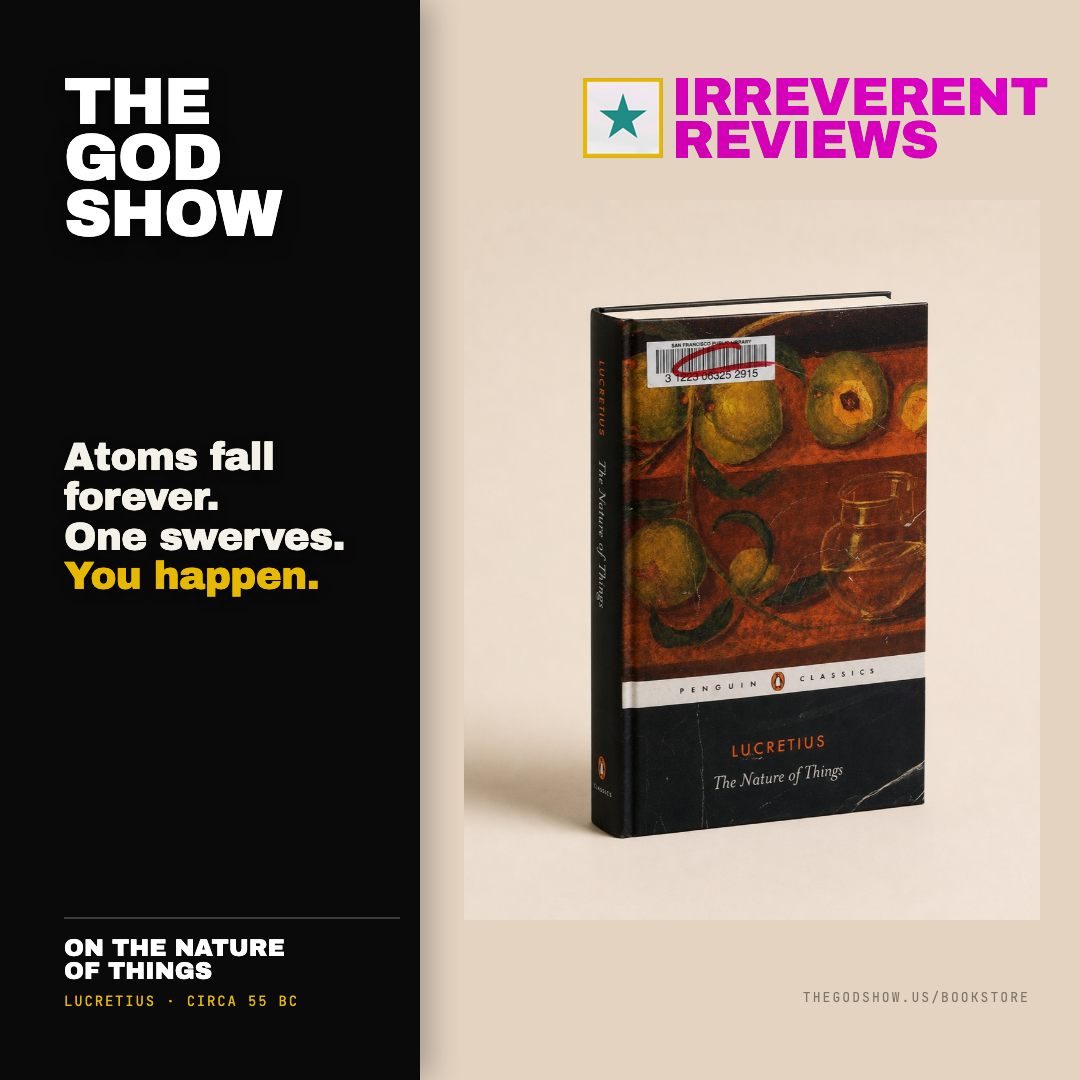
On the Nature of Things
Lucretius · Circa 55 BC
Rome's strangest masterpiece: a physics textbook in hexameter that debunks the gods, dismantles romance, and ends mid-plague with the heavens conspicuously silent.
Buy on Amazon →We know almost nothing about Titus Lucretius Carus—no reliable dates, no career, barely a sentence of biography that is not suspect. What we have is the project, and the project is deranged in the grandest way. He set out to save Rome's soul by proving it didn't have one. On the Nature of Things is roughly 7,400 lines of hexameter—physics textbook, ethics manual, and anti-superstition pamphlet welded into a single poem—arguing that everything, including you, is atoms and void, that the gods don't take meetings, and that the fear of death is the saboteur behind half of human cruelty. The only 'biography' we have is a smear from St. Jerome four centuries later: love potion, madness, lucid intervals, suicide at forty-four. Almost certainly slander. Also, infuriatingly, a perfect blurb.
Atoms, Void, and One Lucky Swerve
Lucretius knew the medicine was bitter, so he glazed the cup with honey—his own image for the gorgeous verse wrapped around hardcore Epicurean physics. The doctrine underneath is uncut materialism. Nothing comes from nothing. Everything is particles falling through infinite void, recombining the way letters recombine into new words—his analogy, and still the best one anyone has found. And then the famous patch: every so often, unpredictably, an atom swerves—a tiny, causeless sidestep that breaks the iron chain of fate. From that one wobble Lucretius gets collision, creation, novelty, and free will. Philosophers still argue whether this is profound or a hack. Either way, it is the only time in literary history a rounding error has been asked to carry the entire weight of human freedom.
Book Four Will Ruin Date Night
After the cosmology comes the most savage breakup letter in classical literature. Lucretius on romantic passion is merciless: lovers bite and press and strain to fuse into one body, and they cannot, ever—just two surfaces grinding at an unbridgeable seam. Desire inflames; possession disappoints; obsession metastasizes. His prescription is deflationary: demystify the beloved, manage the appetite, never mortgage your tranquility to another nervous system. In 2026, with limerence rebranded as content and parasocial longing available by subscription, Book Four reads less like ancient prudery and more like the first systems analysis of the thirst trap.
It Ends With a Plague, and No Moral
The poem opens with a hymn to Venus and ends, mid-breath, in the Plague of Athens: bodies in the streets, temples stuffed with corpses, the gods serenely useless. Whether Lucretius died before finishing or planned the gut-punch, scholars still brawl. But the ending is the argument. No deity intervenes because no deity was ever going to; the universe is not cruel, it is indifferent, and the difference is the liberating part. Earlier in the poem he points at Iphigenia—a daughter butchered to buy wind for a fleet—as Exhibit A for how much evil superstition can talk people into. The plague is Exhibit B: heaven's silence, documented.
“He set out to save Rome's soul by proving it didn't have one.”
Verdict
Read it for the audacity: a man staring down death, love, lightning, and the gods with nothing but particles and meter. The poem's bet is that wonder survives the autopsy—that a universe of atoms swerving in the dark is more consoling, not less, than one run by moody immortals. Two millennia on, the bet still pays. To the swerve, then—the luckiest wobble in the universe, and the reason you were available to read about it.