



Irreverent Reviews
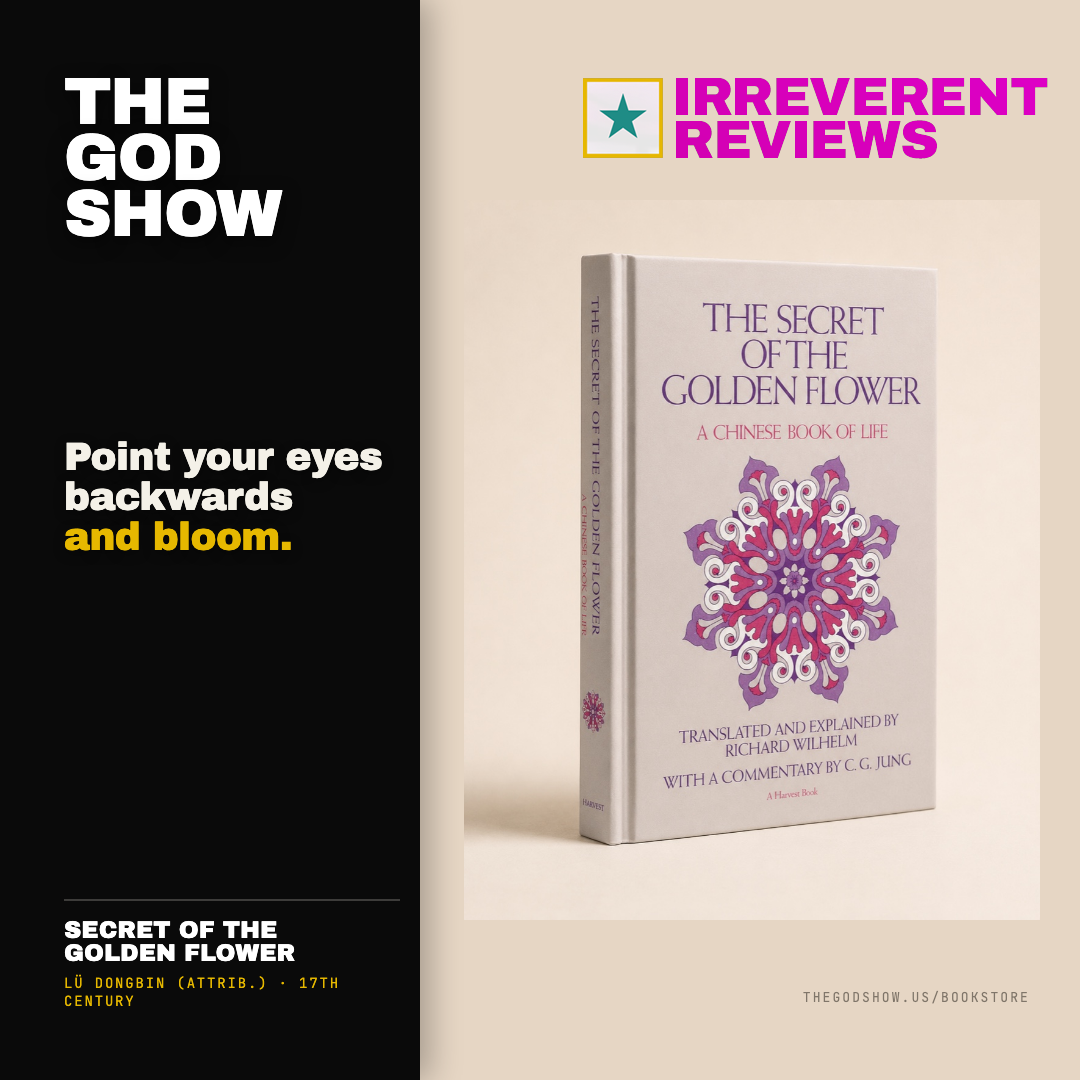
The Secret of the Golden Flower
Lü Dongbin (attributed) · Circa 17th century
A Taoist alchemy manual dictated by a dead immortal, translated by a missionary who converted no one, and annexed by Carl Jung as evidence for Carl Jung.
Buy on Amazon →This is the strangest supply chain in publishing. The text was attributed to Lü Dongbin, a Tang-dynasty immortal, by Chinese spirit-writing circles around the seventeenth century—meaning the author had, by the most generous accounting, been dead for eight hundred years when he dictated it through a planchette. Richard Wilhelm, a German missionary in Qingdao who liked to boast that he never baptized a single Chinese convert, translated it in 1929. Carl Jung then wrote a commentary explaining that this Taoist meditation manual confirmed everything Carl Jung had been thinking. The little book has been blooming in other people's gardens ever since.
Turn the Light Around
Strip away the alchemical brocade and the method is one shocking move: your attention pours out of you all day, splashed across the world; reverse it. Turn the light around—circulate awareness back toward its own source, breath after breath, until something opens that the text calls the golden flower, a body of light assembled in the dark behind your eyes. It is inner alchemy with no lab equipment: the furnace is attention, the elixir is you. In 2026, meditation apps sell the same maneuver as a focus feature with streak badges; the immortals, to their credit, did not include streak badges.
Jung's Souvenir
Wilhelm mailed the translation to Jung in 1928, catching the psychiatrist mid-obsession with the mandalas he had been painting, and Jung seized on the golden flower as independent confirmation of the collective unconscious. His commentary famously warns Europeans not to imitate Eastern practices—advice he issues while strip-mining one for his own psychology. A dead immortal dictated it, a missionary mangled it, and a psychiatrist mined it for proof of himself. The mangling is not a joke, either: Thomas Cleary's 1991 retranslation argued Wilhelm had worked from a corrupted, truncated edition—meaning the West's gateway to Taoist meditation was a photocopy of a photocopy, lovingly annotated by a man looking in a mirror.
“A dead immortal dictated it, a missionary mangled it, and a psychiatrist mined it for proof of himself.”
Verdict
And yet the instruction at the center survives every hand it passes through, which may be the strongest argument that there is something real in it. Read Wilhelm for the history, Cleary for the accuracy, and then sit down, close your eyes, and try the one thing every version agrees on. To the golden flower: may it keep blooming in the dark, no matter who claims the garden.