








































Irreverent Reviews
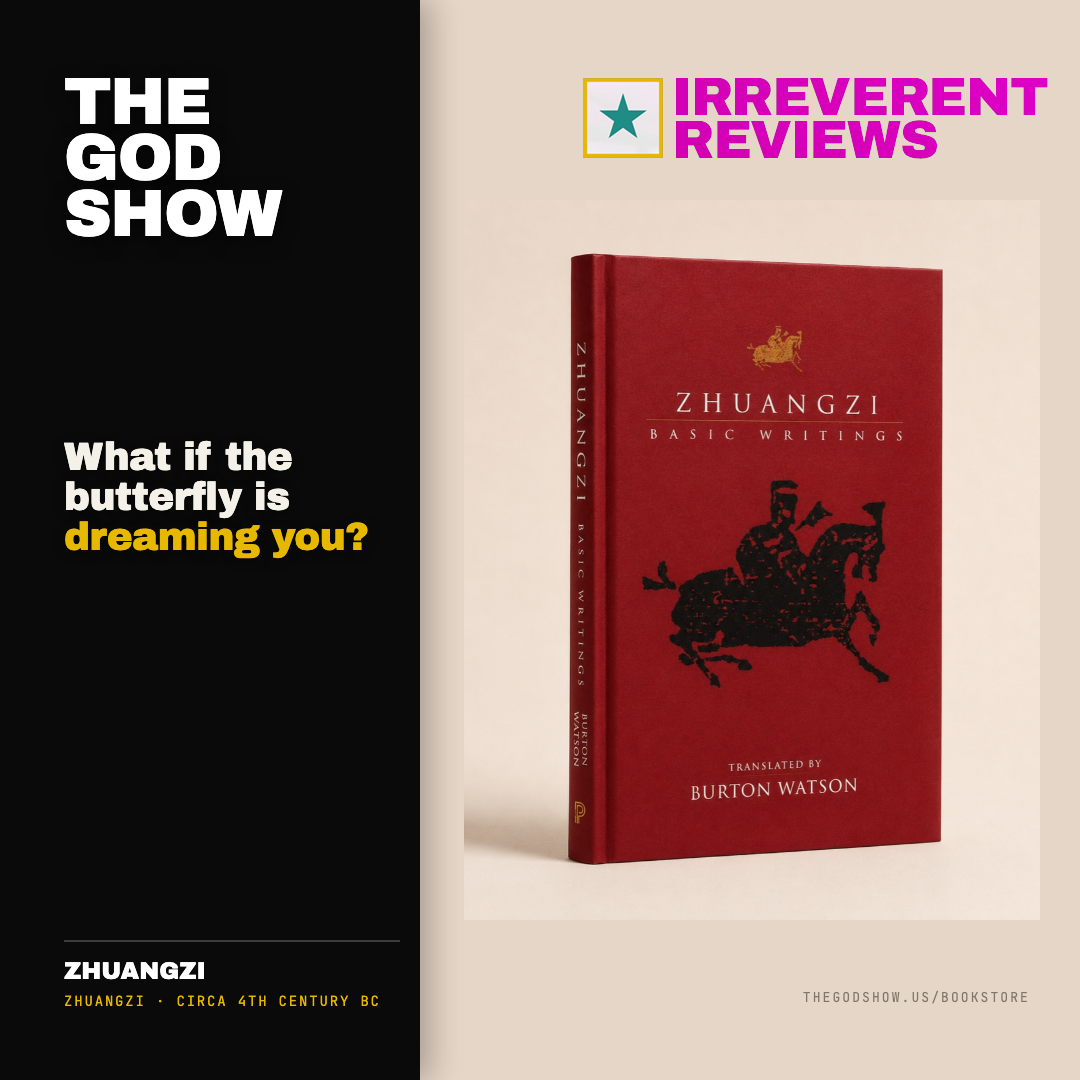
Zhuangzi: Basic Writings
Zhuangzi · Circa 4th century BC
The funniest man in ancient China wrote the only scripture that giggles: dead skulls, useless trees, debating fish, and a butterfly with an identity problem.
Buy on Amazon →Fourth-century BC China was a slaughterhouse—collapsing kingdoms, mass conscription, philosophers hawking rival rescue plans at every court. A minor official from the town of Meng surveyed the wreckage and decided the sanest possible response was jokes. Zhuangzi is the only founder of a world tradition who is actively trying to make you laugh. His book is a carnival of talking skulls, debating fishermen, gnarled trees, and one extremely famous butterfly, and Burton Watson's translation—the gold standard since 1964—is loose enough to let the comedy breathe. Laozi whispers; Zhuangzi does bits.
The Butterfly Has Questions
The famous setup: Zhuangzi dreams he is a butterfly, flitting around without a thought for Zhuangzi. He wakes, and the floor drops—is he a man who dreamed he was a butterfly, or a butterfly now dreaming it is a man? This is not stoner musing. It is a demolition of fixed perspective, the engine of the whole book: every certainty you hold is held from somewhere, and the somewhere can move. His debating partner Huizi keeps lunging at him with logic—how can you know what fish enjoy?—and Zhuangzi keeps stepping aside like a matador with a grin.
Then there is Cook Ding, the butcher whose blade stays sharp for nineteen years because he carves along the ox's natural seams instead of hacking through bone. It is the oldest description of flow state on record. In 2026, productivity gurus sell that exact state back to you as a $499 course; Cook Ding never billed by the hour.
Useless Trees and Singing Widowers
Zhuangzi's survival strategy is uselessness. The tree too crooked for lumber is the one no axe visits—it outlives the whole straight forest. Offered a prime ministership, he asks the king's messengers whether a sacred tortoise would rather be dead and venerated in a shrine or alive and dragging its tail in the mud, then tells them to leave him in the mud. When his wife dies, a friend finds him drumming on a tub and singing—not from callousness, but because he has followed her change the way you follow the seasons, and grief sung is still grief. Even death gets a bit: a roadside skull appears to him in a dream and refuses the offer of resurrection, insisting the dead have it better than kings.
“Zhuangzi is the only founder of a world tradition who is actively trying to make you laugh.”
Verdict
Laozi hands you aphorisms to govern by; Zhuangzi pulls the throne out from under you and laughs when you land, then helps you up and does it again. Watson's edition is the rare classic you will actually finish, because it keeps doing the one thing scripture never does: it giggles. Find a tub. Drum on it.