




























Irreverent Reviews
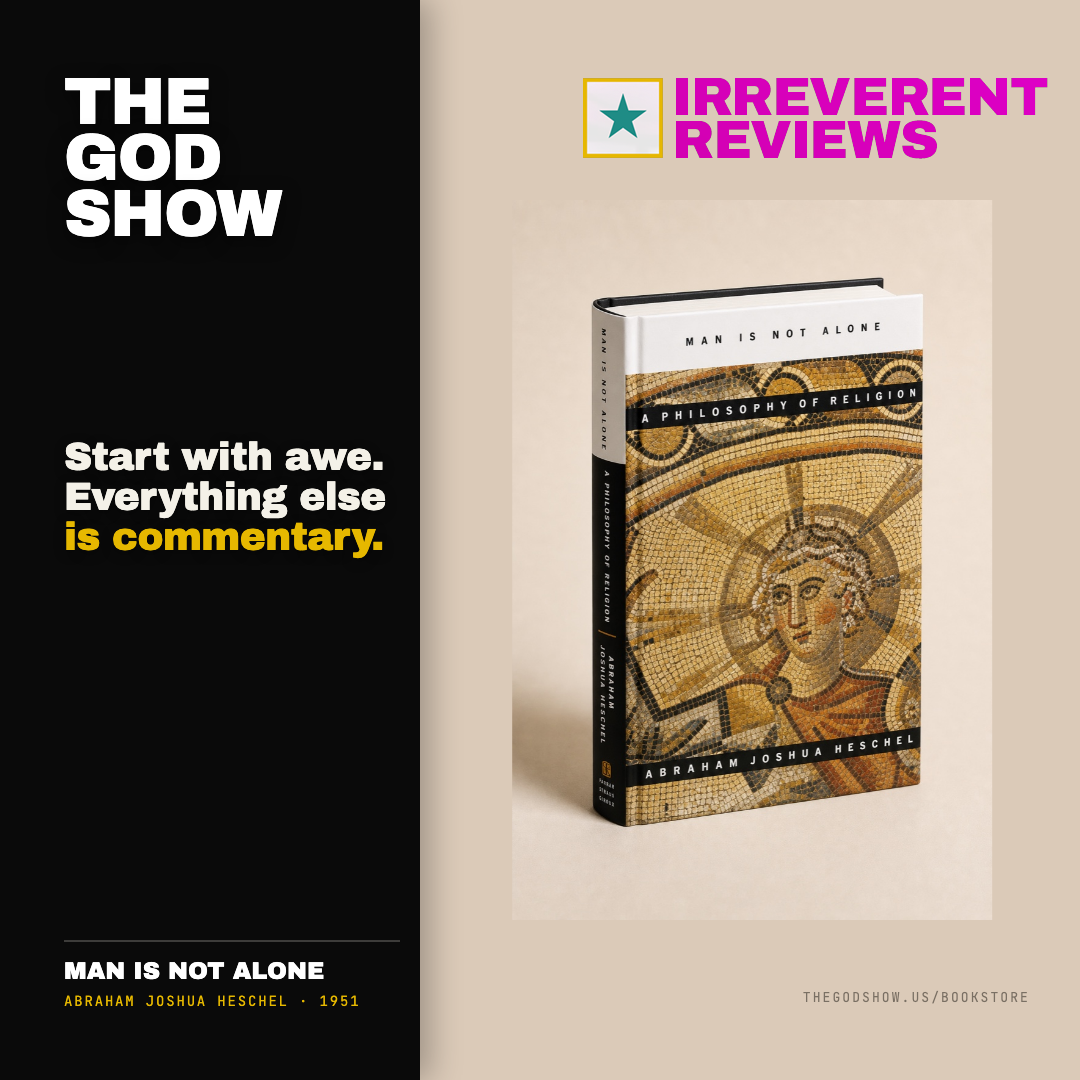
Man Is Not Alone
Abraham Joshua Heschel · 1951
A Hasidic prince who slipped out of Warsaw six weeks ahead of the Wehrmacht rebuilt faith in America on one premise: wonder first, doctrine later.
Buy on Amazon →Abraham Joshua Heschel was Hasidic royalty—descended from rebbes on both sides, groomed from boyhood in Warsaw to inherit a dynasty—and he defected to philosophy, writing a Berlin doctorate on the prophets while the Nazis were taking Berlin. They deported him back to Poland in 1938; he got out through London six weeks before the Wehrmacht arrived. His mother and three of his sisters did not survive. The man who reached America described himself as a brand plucked from the fire, and then did something stranger than despair: in 1951 he published Man Is Not Alone, a philosophy of religion arguing that faith begins not in argument, not in institutions, not even in scripture, but in the raw pre-conceptual shock he named radical amazement—the sheer scandal that anything exists at all. Reinhold Niebuhr reviewed it and predicted Heschel would become a commanding voice in American religious life. For once a theologian's prophecy held.
Radical Amazement
Philosophy, Heschel says, begins in doubt; religion begins earlier. Before you can question the world you have to be floored by it, and that floored-ness is not decoration—it is data. Awe, for Heschel, is not a feeling; it is a form of intelligence. The ineffable is not mush; it is the part of every experience that outruns description, and modernity's signature disease is taking things for granted—worship by habit, wonder outsourced, the universe filed under 'handled.' He warns that humanity is less likely to perish from a shortage of information than from a shortage of appreciation. And against his era's confident reducers—religion as need, as neurosis, as opiate—he runs the arrow backward: God is not a product of human need; the human being is, perhaps, something God needs. The audacity is the architecture.
The Proof Was the Life
What keeps the book from floating off into incense is what its author did next. The philosopher of divine pathos—the claim, outrageous to Aristotle and to most seminaries, that God is no unmoved mover but a Being who grieves and pursues—spent the sixties acting like it. He marched in the front row at Selma beside King, white-bearded and windblown in the photograph everyone has seen, and said afterward that he felt as if his legs were praying. He hectored presidents on civil rights and helped lead the clergy revolt against Vietnam. In 2026, with the attention economy strip-mining the precise faculty he called holy, radical amazement reads less like mysticism and more like resistance training—a daily refusal to let the world shrink to a notification. The book is the theory; Selma was the peer review.
“Awe, for Heschel, is not a feeling; it is a form of intelligence.”
Verdict
Man Is Not Alone offers no proofs and apologizes for nothing; it simply relocates the question. Not 'does God exist'—Heschel finds the whole courtroom posture absurd—but whether you have ever actually looked at anything long enough to be astonished. Read ten pages at dusk and check your pulse. L'chaim to the brand plucked from the fire: three-quarters of a century on, still throwing sparks.