





















Irreverent Reviews
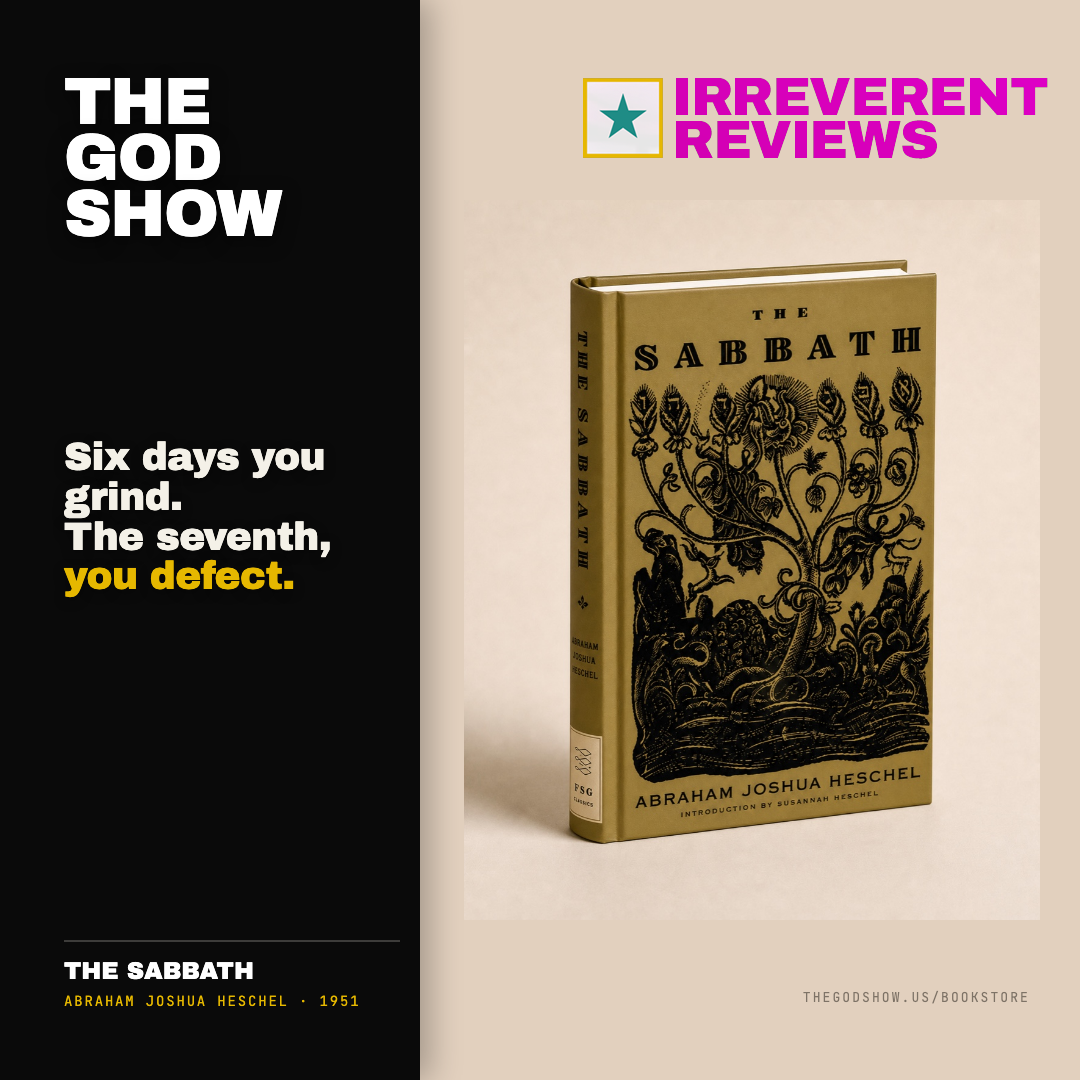
The Sabbath
Abraham Joshua Heschel · 1951
A hundred pages from 1951 that diagnose burnout better than your therapist, your sleep app, and your out-of-office reply combined.
Buy on Amazon →In the same annus mirabilis of 1951 that produced Man Is Not Alone, Heschel published this hundred-page prose poem, cut with Ilya Schor's woodcuts, and detonated one observation under all of Western striving: the first thing the Bible calls holy is not a mountain, not a temple, not a person. It is a day. From that, a thesis: Judaism is a religion of time, not space—a civilization that builds its cathedrals out of hours, his famous palace in time—while what he politely calls technical civilization wages a war for space, the conquest and accumulation of things. Postwar America, then busy unboxing its suburbs, tailfins, and televisions, had just been informed by a Warsaw-born Hasid that it was winning the wrong war.
Menuha Is Not a Nap
Heschel retrieves an old rabbinic notion that creation was not actually finished on the sixth day, because something was still missing: menuha—rest itself, which the seventh day created. Rest, in this account, is not the absence of work, not recovery, not the body's cooldown lap; it is a positive substance, a made thing, tranquility with ontological weight. That quietly inverts every productivity argument since the steam whistle. The Sabbath is not for the sake of the workweek; the workweek is for the sake of the Sabbath. One day in seven, commerce, building, and optimizing are not paused but dethroned, and the day stops being a layover on the way to Monday. The day is the destination—eternity running its weekly dress rehearsal.
The Original Right to Disconnect
Every weekend you have ever enjoyed is this idea with the theology drained out—the Sabbath secularized, unionized, and then quietly handed back to your employer via the phone on your nightstand. Heschel calls the bluff of a civilization that owns everything and inhabits nothing. He saw in 1951 that the conquest of space was accelerating while the experience of time collapsed; he did not foresee the supercomputer in your pocket, but he diagnosed its business model. In 2026, rest has been rebranded as recovery—a maintenance window between sprints, scored by a ring on your finger—and the most radical sentence available is the one this book is built on: the day off is the point of the week, not its pit stop. Nations now legislate a right to disconnect. Heschel would note, gently, that the tradition shipped that feature about three thousand years ago, bundled with candles.
“Heschel calls the bluff of a civilization that owns everything and inhabits nothing.”
Verdict
It is the shortest great book in modern religious writing, and the least optional. You do not need the faith to run the experiment: one sundown to the next—no buying, no selling, no performing, no feed. If twenty-five unmonetized hours sounds terrifying, that is not an objection; that is the diagnosis. Light two candles. Silence one phone. To the seventh day—the only palace no army has ever taken.