































Irreverent Reviews
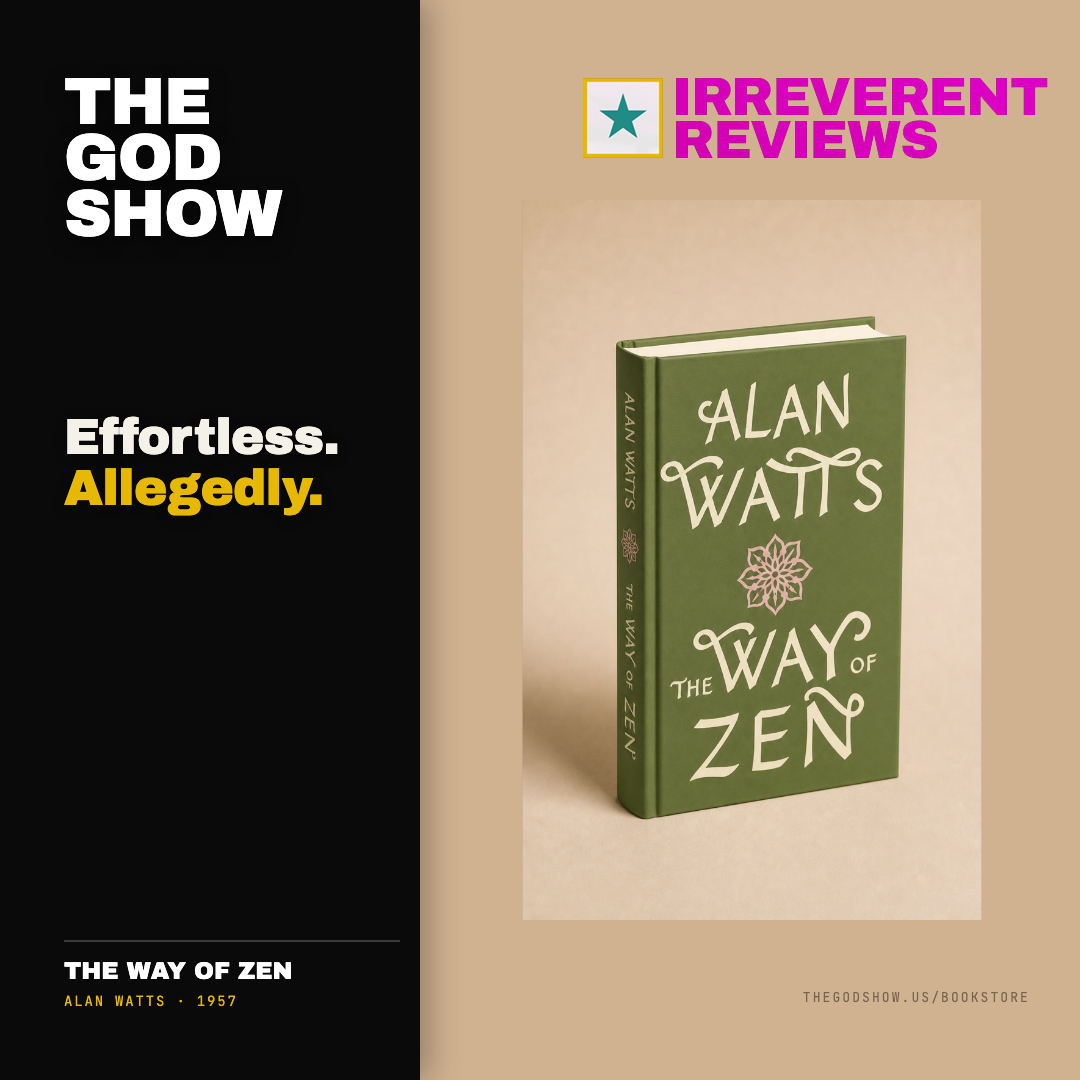
The Way of Zen
Alan Watts · 1957
A defrocked priest with a BBC accent and a cocktail explained Japan's least explainable tradition to the West—and the purists never forgave how well it sold.
Buy on Amazon →Alan Watts published his first book on Zen at twenty-one, became an Episcopal priest at thirty, lost the collar at thirty-five when his marriage imploded in public, and washed up in San Francisco as a radio philosopher with a plummy accent, a cocktail within reach, and a genius for explaining the unexplainable. In 1957 he pulled off the improbable: a rigorous, beautiful, genuinely useful account of Zen for people who could not tell a koan from a kimono. The purists have been furious ever since, mostly because it worked.
The Double-Bind at the Bottom of Everything
The book runs in two halves—history, then practice. The history is real scholarship for its day: Zen traced honestly to its Taoist groundwater, through Mahayana India, into Tang-dynasty China where it became Chan, and on to Japan, where it acquired the name and the aesthetics. The practice half walks through zazen, koan study, and the arts—tea, haiku, gardens—without pretending any of it can be captured in prose. The philosophical core is the double-bind: be spontaneous, on command. Relax, harder. Crave enlightenment, although craving is the disease. A koan, in Watts's telling, is an engineered head-on collision with that paradox—the eye straining to see itself, the hand snatching at its own grip. The self that is trying to improve the self is the problem wearing a disguise.
The Genuine Fake
The gossip is luxurious. His first mother-in-law was American Zen royalty—Ruth Fuller, of the First Zen Institute—so Watts married into the tradition before he ever lectured on it. Kerouac put him in The Dharma Bums under a fake name. His own 1958 essay scolded Beat Zen and Square Zen with equal relish. The purists sneered that he barely sat zazen, and he barely argued—he preferred talking, called himself a philosophical entertainer, and his biographer settled the question for the ages by titling the book Genuine Fake. Yet when a student trash-talked Watts, Shunryu Suzuki—the genuine article by anyone's count—reportedly shut it down on the spot, calling him a great bodhisattva. Both verdicts are true. He monetized the dharma. He also delivered it.
Death and the Algorithm
Three marriages, seven children, the drinking, dead in his sleep at fifty-eight in a cabin on Mount Tamalpais in 1973. Then the resurrection nobody predicted: In 2026 his baritone floats over lo-fi beats in a million feeds, minute-long clips strip-mined from decades of lectures, making him the most-heard Zen voice in human history—a fate that vindicates and indicts him in the same breath. The clips sell Zen as a vibe. The book is better, because it is the one place Watts shows his homework.
“The self that is trying to improve the self is the problem wearing a disguise.”
Verdict
Read The Way of Zen the way Watts intended: not as scripture but as a superb guest lecture by a man who knew the limits of lectures and gave them anyway. Scholars have corrected details; nobody has built a better front door. He liked to warn that the menu is not the meal—fine. He wrote the best menu in the business. Order accordingly, and tip the genuine fake on your way out.