



























































Irreverent Reviews
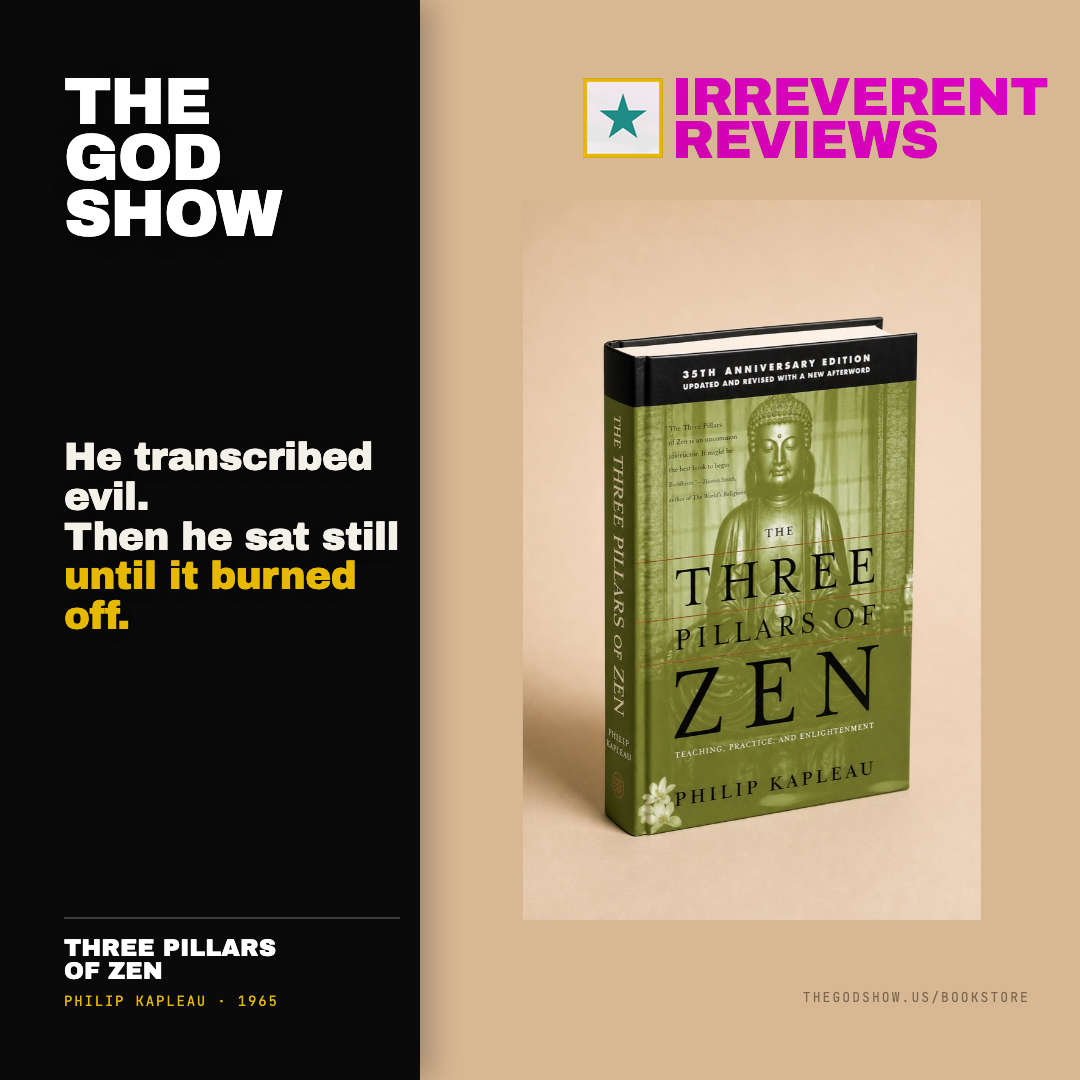
The Three Pillars of Zen
Philip Kapleau · 1965
A Nuremberg court reporter transcribes humanity's worst, develops ulcers, flies to Japan at 41, and returns with the West's first real instruction manual for zazen.
Buy on Amazon →Philip Kapleau spent the 1940s as a court reporter at the Nuremberg and Tokyo war crimes trials, taking down humanity's absolute worst at professional speed. The job paid well and hollowed him out: ulcers, allergies, a nervous system filing for divorce. He tried D.T. Suzuki's celebrated Zen lectures at Columbia and found them brilliant and useless — philosophy about the raft, no raft. So in 1953, at forty-one, he sold his business, flew to Japan, and spent thirteen years in monasteries under Harada-roshi and then Yasutani-roshi, getting his certainties beaten out of him one frozen sitting at a time. He transcribed evil. Then he sat still until it burned off. The Three Pillars of Zen is what he carried back.
Stop Reading About Zen
Before 1965, English-language Zen was essays — Suzuki's erudition, Alan Watts' cocktail-hour sparkle. Beautiful menus, no food. Kapleau published the operating manual: Yasutani's introductory lectures on how to actually sit — posture, breath counting, what to do with the carnival in your skull — plus, scandalously, transcripts of dokusan, the private teacher-student interviews that Japanese Zen had kept behind closed doors for centuries. The establishment was appalled. Westerners finally saw the thing itself: students hauling their terror, boredom, and counterfeit breakthroughs to a teacher who swats them all aside. The book closes with contemporary enlightenment accounts — a Japanese executive, an American housewife — ordinary people cracking open on schedule. Enlightenment is not a spa day; it is a demolition.
Pain Is the Curriculum
Kapleau does not sell comfort. His Zen involves knees on fire, seven-day retreats, and the kyosaku — the flat stick that meets your shoulder when you sag. In 2026, meditation apps promise regulation in ten minutes with a celebrity whisper track; Three Pillars proposes that you sit through the screaming and find out exactly who is screaming. The retreat chapters read like sports writing from a war: the days blur, the legs give out, and somebody in the back row breaks through at 3 a.m. and laughs like a man acquitted of everything. Kapleau founded the Rochester Zen Center in 1966, then broke with his own master Yasutani over whether Americans could chant in English — he bet on English, lost the lineage paperwork, kept the students. He practiced through Parkinson's until his death at ninety-one. The man did not skim.
“Enlightenment is not a spa day; it is a demolition.”
Verdict
The Three Pillars of Zen remains the book you hand someone who has read every Zen book and still can't sit for five minutes. It has never gone out of print because it solves the actual problem: not what Zen means, but what you do at 6 a.m. with a cushion and your own unbearable mind. Pour something bracing for the stenographer of horrors who went looking for the bottom of the mind — then sit down before you finish the chapter.