








Irreverent Reviews
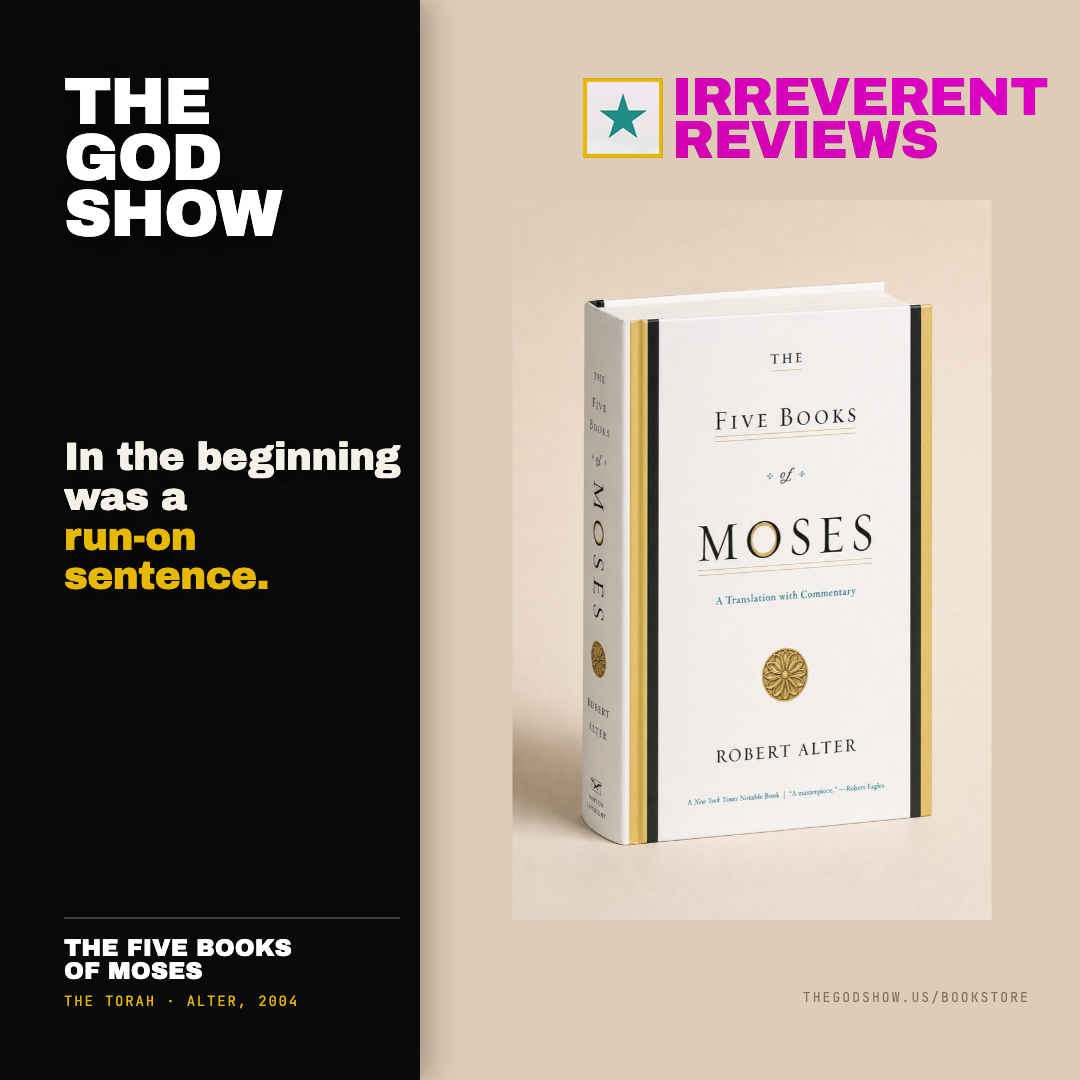
The Five Books of Moses
The Torah · Alter, 2004
Berkeley's crankiest literary critic retranslates the Torah to rescue it from committees—and his footnotes throw elbows at every Bible in the hotel drawer.
Buy on Amazon →Robert Alter spent the 1980s committing a scandal in plain sight: he read the Bible as if it were written by writers. The Art of Biblical Narrative argued that the Hebrew Bible is sophisticated literary art—patterned repetition, loaded puns, scenes engineered down to the syllable—and the rest of his career followed the implication to its logical end: if this is literature, then most modern translations are vandalism. The Five Books of Moses is the counter-offensive—Genesis through Deuteronomy with the Hebrew's muscle restored, defended in footnotes that swallow half of every page, where philology meets connoisseurship and Alter conducts a decades-long brawl against what he calls the heresy of explanation: the translator's urge to explain God's strange prose instead of translating it.
Welter and Waste
Where the King James has the young earth 'without form, and void,' Alter chases the sound of the Hebrew tohu va-vohu and lands on 'welter and waste'—alliteration as fidelity, chaos you can actually hear. That is the method in miniature. Keep the rhythm, because the rhythm is meaning. Keep the repetitions; they are load-bearing. Keep 'hand' and 'seed' and 'flesh' bodily, because the Torah thinks in flesh, not in concepts. The prose comes out ancient instead of beige, and the famous parataxis—clause chained to clause with 'and,' no subordination, no editorializing—turns out to be a theology: events arrive the way they arrive to people, one thing after another, judgment withheld. In 2026, when most prose is extruded by autocomplete into frictionless paste, Alter's footnotes read like a resistance manual. Every 'and' is a decision.
A Family You Wouldn't Lend Money To
Read straight through as story, the material is feral. The patriarchs are not saints; they are a family you would not lend money to. Jacob swindles his brother and is swindled in turn by his father-in-law; Rachel steals the household gods and lies to her father about it; Joseph's brothers sell him south and launder the evidence in goat's blood. Alter's notes track the wordplay like a detective—garments keep doing the lying all through the Joseph story—while respecting the seams: this is a weave of sources from different centuries, stitched by a redactor Alter treats as the final artist rather than a clumsy librarian. Then the gauntlet. Leviticus, a procedure manual daring you onward; Numbers, a census that detonates into mutiny; Deuteronomy, Moses preaching his own farewell. And the ending—the prophet dies on the wrong side of the river, buried by God himself in a grave no one can ever visit—remains the most devastating unmarked exit in world literature.
“The patriarchs are not saints; they are a family you would not lend money to.”
Verdict
This is the rare monument of scholarship that doubles as a page-turner about sibling fraud. Believers get their text back with its teeth; unbelievers get one of literature's founding documents without the laugh track of false smoothness; everyone gets footnotes worth the cover price alone. Buy it for the apparatus; stay for the death of Moses. Pour something old enough to have sediment. To strangeness, restored.