








Irreverent Reviews
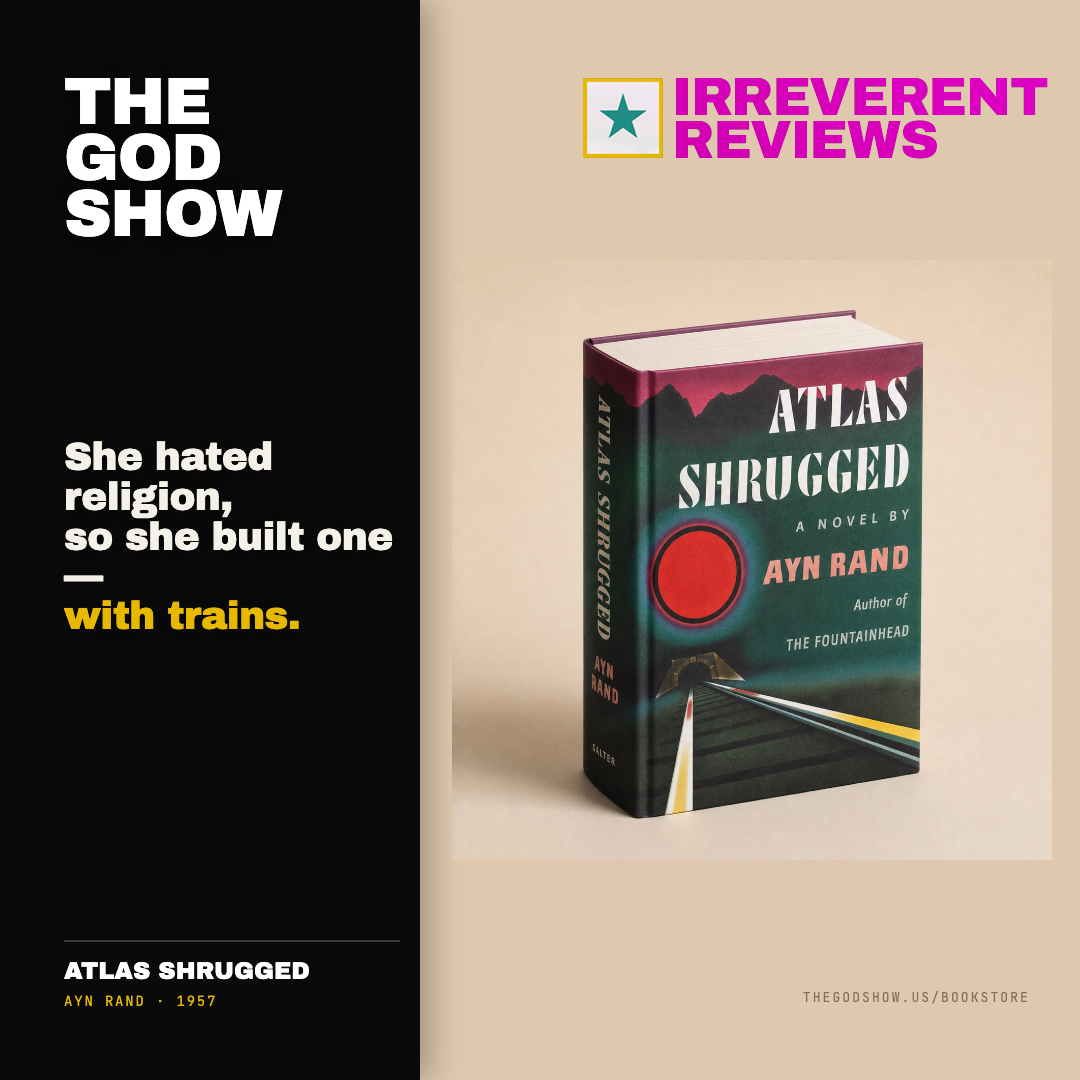
Atlas Shrugged
Ayn Rand · 1957
A thousand-page prophecy where the world ends because rich people's feelings get hurt — and the founding text of a faith that swears it isn't one.
Buy on Amazon →In 1957 Ayn Rand — Russian refugee, Hollywood screenwriter, amphetamine-assisted workhorse — published an eleven-hundred-page novel in which the world ends because the competent people get their feelings hurt and walk off the job. Critics torched it; Whittaker Chambers' notorious review essentially heard the prose ordering dissenters to a gas chamber. Readers ignored the critics and have kept ignoring them through every recession since, because Atlas Shrugged is not actually a novel. It's a religion with a prophet, a scripture, an oath, and a heresy trial — everything but the humility to call itself a church.
The Sermon on the Motor
Give Rand her due: the book argues something, at industrial length. Reason is humanity's only means of survival; trading value for value is the only moral relationship between people; need is not a claim on anyone else's life; A is A, with apologies to Aristotle. The plot is a theological strike — John Galt persuades the world's inventors and industrialists to withdraw their sanction, the motor of the world quietly stops, and civilization discovers what it was free-riding on. There is a money speech that stands among the great ideological monologues in American fiction, there are sex scenes conducted like merger negotiations, and there is Galt's climactic radio address, which runs about sixty pages and took Rand roughly two years to write. Her publisher asked for cuts. She declined, on principle, which tells you everything about both the book's integrity and its pacing.
The Collective That Hated Collectives
Now the gossip, which is doctrinally relevant. Rand's inner circle of devotees — including a young Alan Greenspan, future chairman of the Federal Reserve — called themselves, with a wink that curdled, the Collective. They studied the manuscript like scripture before publication. Her chief apostle, Nathaniel Branden, ran the institute that spread the faith until 1968, when Rand learned of his secret affair and excommunicated him with an encyclical in her own newsletter. The movement recited an oath of egoism straight out of Galt's mouth. None of this is a smear; it is the point. A philosophy of radical independence produced one of the most obedience-heavy intellectual scenes of its century, and the lesson sailed past everyone involved. In 2026 the book still spikes on the charts every time the economy coughs, and its loudest devotees still build their fortunes on government contracts — the kind of joke Rand's universe has no category for.
“It's a religion with a prophet, a scripture, an oath, and a heresy trial — everything but the humility to call itself a church.”
Verdict
Is it worth reading? Honestly, yes — the way Las Vegas is worth seeing. Atlas Shrugged is a complete cosmology executed with terrifying stamina, and you cannot understand half of American politics or a third of Silicon Valley without it. But hold the book to its own standard: judge it by reason, trade your hours for genuine value, and accept no claims on faith — starting with its claim that it isn't a faith. Light a dollar-sign cigarette and check your premises. A is A, and a church is a church.