



















































Irreverent Reviews
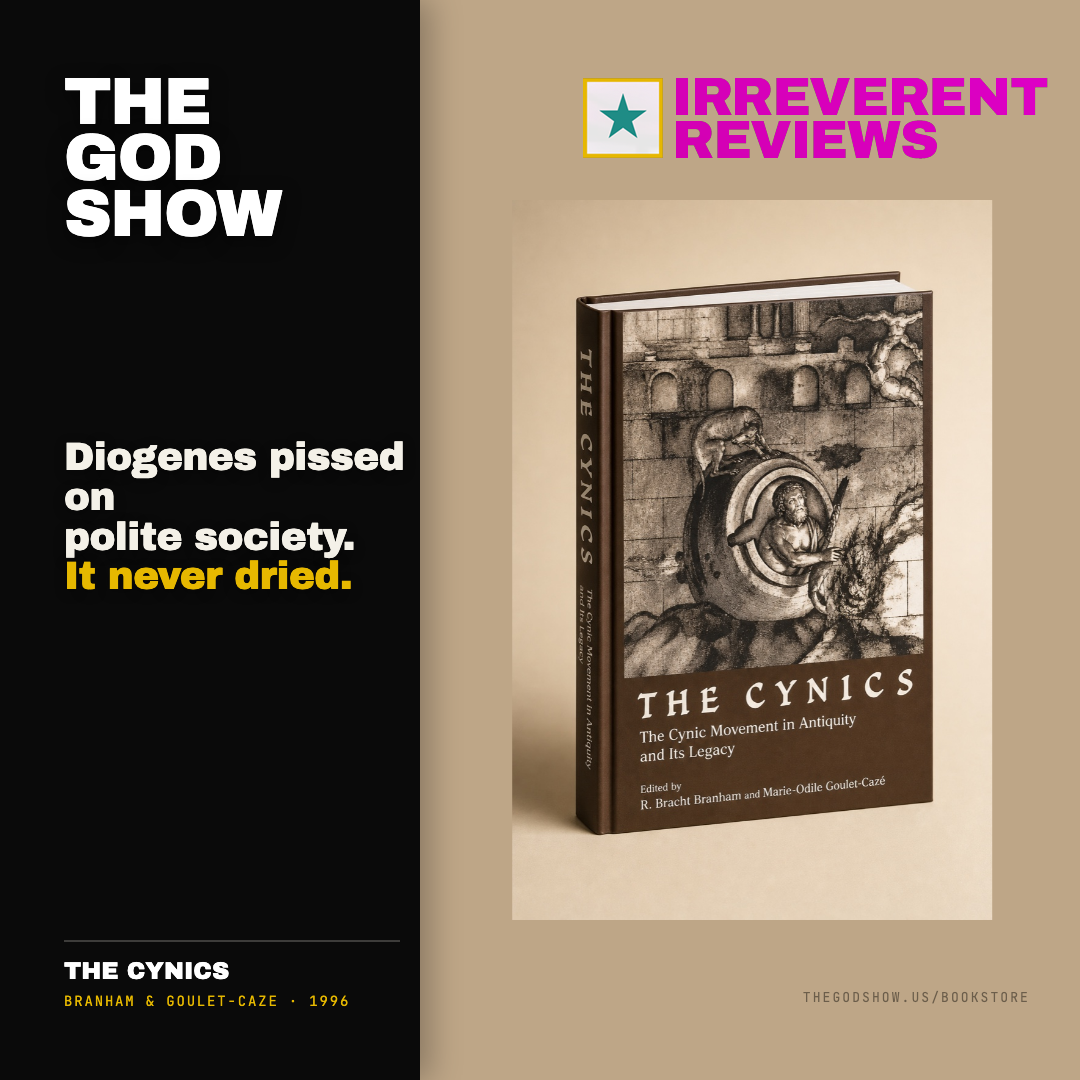
The Cynics
R. Bracht Branham & Marie-Odile Goulet-Caze, eds. · 1996
The definitive scholarly autopsy of philosophy's barking street saints — the dropouts who turned shamelessness into a spiritual discipline.
Buy on Amazon →Most philosophy anthologies are where ideas go to die politely. This one is a kennel. Branham and Goulet-Caze herd an international pack of classicists into one volume to take seriously the least respectable movement in Western thought: the Cynics, the barking dropouts of antiquity who decided that virtue meant owning nothing, shaming everyone, and treating every social convention like a fire hydrant. The result is that rarest of academic objects — a scholarly book about people who would have set it on fire to cook lentils.
The Dog Who Bit Athens
Diogenes of Sinope arrived in Athens as an exile — he and his money-changing father had been run out of town over a scandal involving defaced currency — and he turned the rap sheet into a mission statement: deface the currency of convention itself. He moved into a ceramic storage jar, carried a lamp in broad daylight announcing he was looking for an honest human, and told Alexander the Great, who had offered him anything he desired, to step aside because he was blocking the sun. He performed acts in the marketplace that would get you a registry entry today, then explained, with perfect logic, that he wished all appetites were so easily satisfied. Diogenes turned poverty into a megaphone and shame into a sacrament. The Greeks called him the dog, and he wore the insult like a halo. Cynic literally means doglike. The dog became a school.
From Gutter to Gospel
The essays trace what happened to that filthy lightning. Zeno of Citium studied under the Cynic Crates before founding Stoicism, which means the most respectable philosophy of the Roman boardroom class is the housebroken descendant of a man who lived in a jar. Crates and his wife Hipparchia — one of the only women in ancient philosophy who got to be a philosopher instead of a footnote — practiced their shamelessness as a couple, scandalizing Athens on principle. Later, Epictetus painted the ideal Cynic as a scout sent ahead by God, and the volume wades into the scholarly brawl over whether the historical Jesus — itinerant, propertyless, aphoristic, allergic to wealth — looked suspiciously like a Galilean Cynic. The editors also chart the saddest fate of all: how Cynicism, a discipline of joyful shamelessness, decayed into cynicism, a mood of sneering surrender. The capital letter, it turns out, was holding back the rot. In 2026, when every minimalist influencer sells simplicity with a checkout page and a course, Diogenes stands alone as the one who meant it — he owned a cup until he saw a child drink from cupped hands, then threw the cup away for being luxury.
“Diogenes turned poverty into a megaphone and shame into a sacrament.”
Verdict
This is an academic book, with footnotes and the occasional sentence that requires a sherpa, but it earns its shelf space by refusing to deodorize its subject. The Cynics were holy fools who bet their entire lives on the proposition that freedom is the only wealth and embarrassment is a tax you can simply stop paying. Read it, then look around your apartment with suspicion. Raise a chipped cup to the dog of Athens — then ask, honestly, whether you need the cup.