









Irreverent Reviews
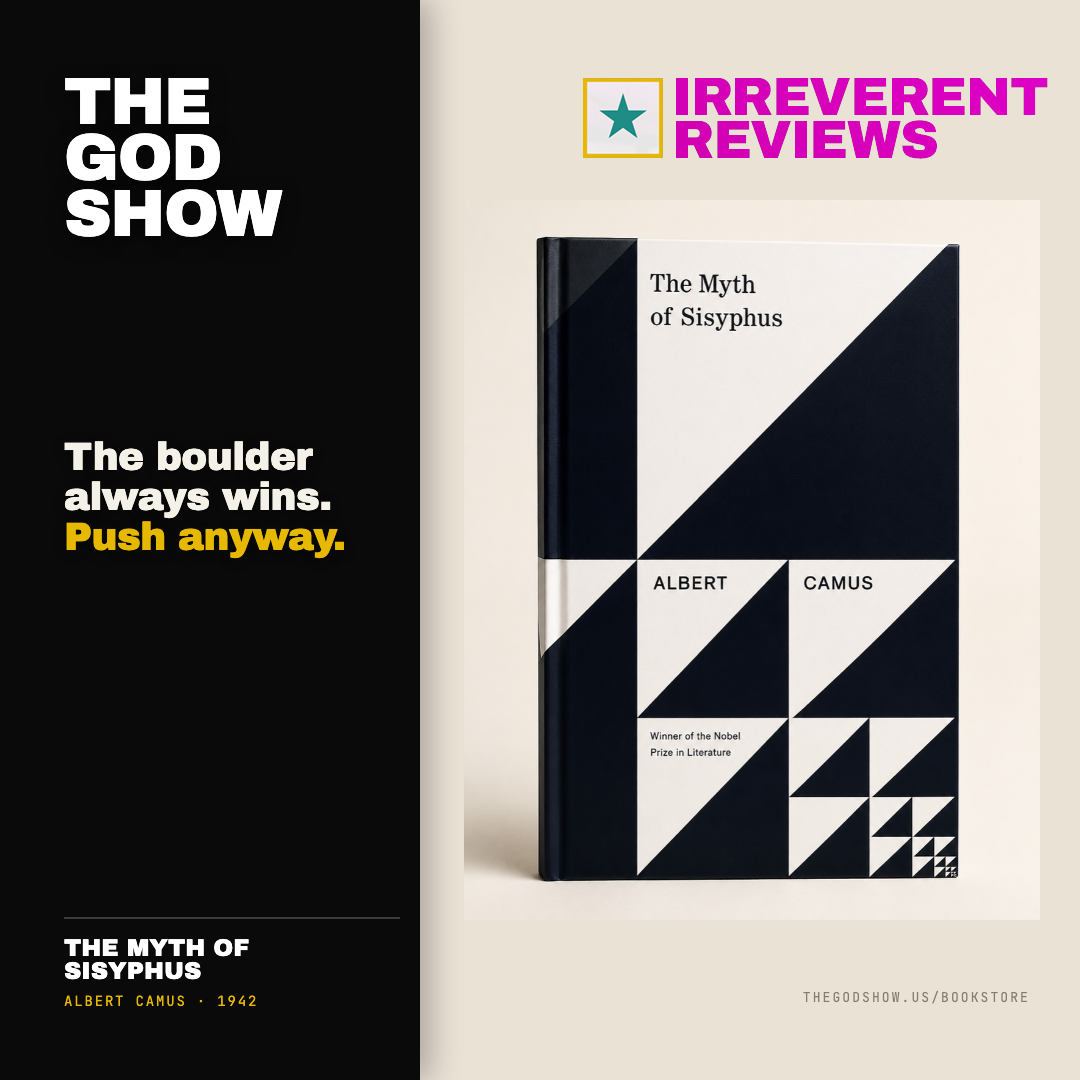
The Myth of Sisyphus
Albert Camus · 1942
A 29-year-old with tuberculosis sits down in the middle of a world war to decide whether life is worth living, and files the strangest yes in philosophy.
Buy on Amazon →Albert Camus opens The Myth of Sisyphus by declaring that there is exactly one serious philosophical problem, and it is whether to go on living. He was not yet thirty: an Algerian pied-noir raised in real poverty by a near-deaf, illiterate mother, a promising goalkeeper until tuberculosis benched him at seventeen, now coughing through a relapse while Europe burned. The essay he produced is the least depressing book about meaninglessness ever written — a manual for staying alive, on purpose, in a universe that declines to explain itself. The universe owes you a meaning the way the sea owes you an apology. Camus's whole project is teaching you to swim in it.
The Absurd Is a Collision, Not a Mood
The absurd, for Camus, is not teenage gloom; it is arithmetic. Take one human hardwired to demand meaning, add one universe that issues none, and the absurd is the spark gap between them — a divorce, not a property of either party. His scandal is what he does next: nothing. No God, no leap of faith, no exit, because all three dissolve one side of the equation instead of living the tension. He charges Kierkegaard and company with philosophical suicide — euthanizing their own intelligence to marry a comforting conclusion — which took nerve, given that the entire Parisian intellectual economy ran on exactly that trade. Camus spent the rest of his short life politely refusing the existentialist label everyone kept gluing to him.
Quantity Over Destiny
If nothing means anything, what follows is not despair but a strange spree: revolt, freedom, passion. Camus parades his absurd heroes — Don Juan, who loves serially without the alibi of the One; the actor, who burns through a hundred lives knowing all of them are fake; the conqueror; the artist — people who trade the quality of eternal meaning for the quantity of lived experience. There is gallows trivia in the book's spine, too: the first edition shipped without its Kafka chapter, because praising a Jewish writer was unprintable under the Occupation, so Camus slotted in Dostoevsky and restored Kafka after the war. The censors proofread a book about absurdity and contributed some.
The Descent Is the Whole Point
Then the closer, a few pages that outlived the century: Sisyphus, sentenced by the gods to roll a boulder up a mountain forever and watch it roll back down forever. Everyone remembers the futility; Camus stares at the walk back down. That pause — lucid, unsupervised, free — is where a punishment turns into a life, because the rock is finally, unambiguously, his. In 2026 the burnout think-pieces rediscover Sisyphus roughly weekly, minus the scorn that makes him dangerous; Camus's Sisyphus is not coping, he is winning a rigged game out of spite. Eighteen years after publication the universe filed its rebuttal: Camus died in a car crash with an unused train ticket in his pocket, a punchline he would have rated highly.
“The universe owes you a meaning the way the sea owes you an apology.”
Verdict
Read it at your lowest and it will not cheer you up; it will do something better and make you stubborn. Camus never promises the boulder gets lighter — he promises that lucidity weighs nothing and scorn travels well. No other book extracts this much dignity from this little cosmic cooperation. Cold coffee at the bottom of the hill, then: to the rock, to the legs, and to the next push, which is yours.