




















Irreverent Reviews
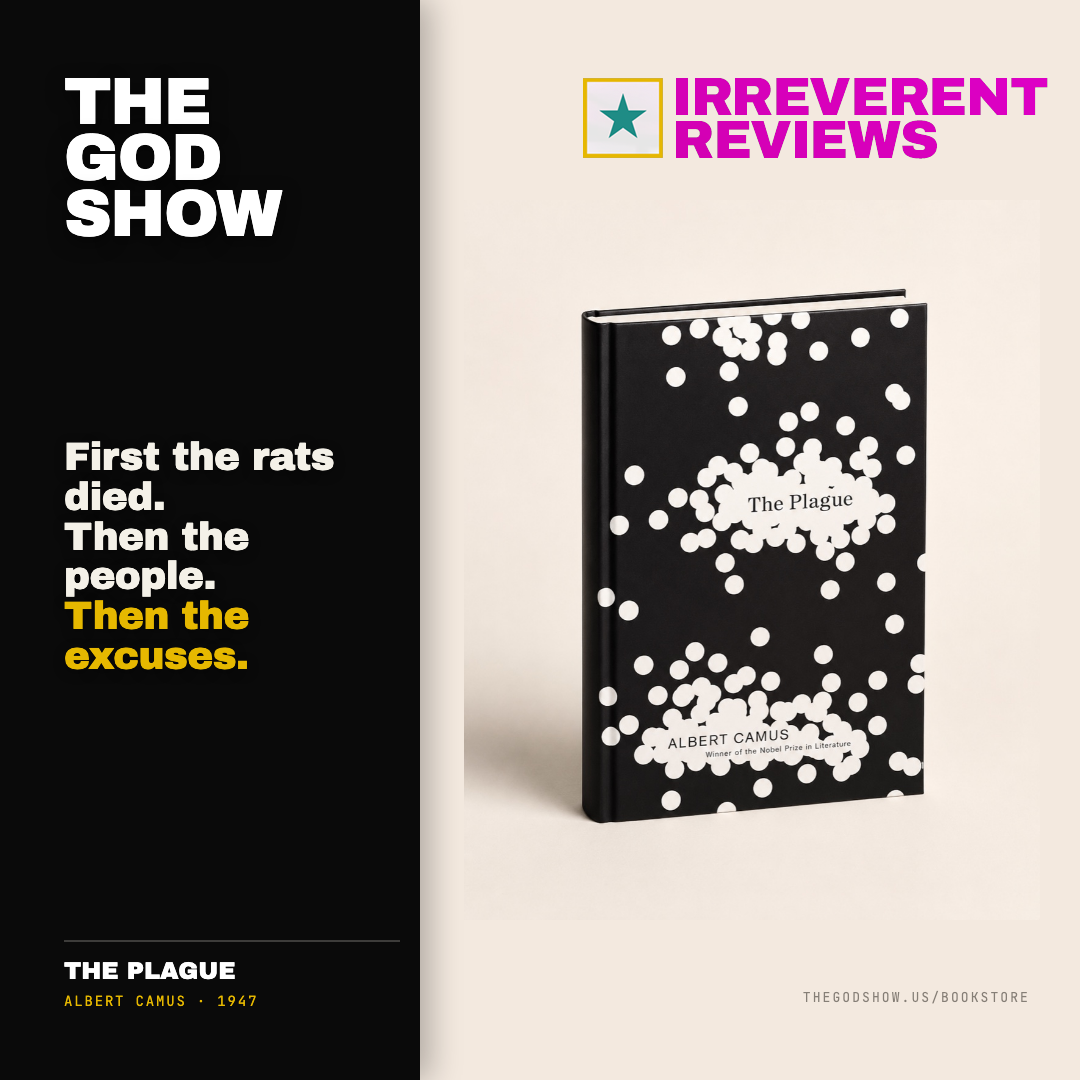
The Plague
Albert Camus · 1947
Camus locks an Algerian port city in quarantine and discovers the only superpower against mass death: doing your job until it kills you.
Buy on Amazon →Camus spent the war editing the Resistance paper Combat, watched Europe relearn mass death, and came home with the least romantic war novel ever written — the enemy is a bacillus, and the resistance is run by a tired doctor, a clerk, and a journalist who would rather be anywhere else. The Plague drops into Oran, a French-Algerian port Camus paints as ugly, commercial, and bored, then starts killing its rats by the thousand. The humans, being humans, debate vocabulary while the bodies accumulate. It is the most accurate novel about institutional denial ever written, and it was supposed to be about fascism.
Heroism, Demoted to a Day Job
Dr. Bernard Rieux fights the epidemic the way you'd fix a drainage system: serums, isolation wards, exhaustion, repeat. Tarrou, a haunted drifter trying to figure out how to be a saint without God, organizes volunteer sanitary squads. Rambert, a Parisian journalist trapped by the quarantine, schemes for months to escape to the woman he loves — then, with the escape finally arranged, stays, having discovered it is shameful to be happy by yourself while everyone else drowns. And Joseph Grand, an aging clerk who cannot get past the first sentence of the novel he's writing, keeps the death statistics in the evenings. The narrator suggests that if this story must have a hero, it's Grand. That is the entire moral program: Camus demotes heroism to paperwork filed during an apocalypse. No destiny, no medals — competence, fatigue, and turning up.
The Priest and the Dying Child
The theological cage match is the novel's core. Father Paneloux's first sermon is confident Old Testament product: the plague is deserved, kneel accordingly. Then Paneloux stands at a bedside and watches a magistrate's small son die slowly and horribly, and the confidence dies with him. His second sermon is barely a sermon — believe everything or deny everything, there is no middle seat on this flight. Rieux, the atheist, rejects the whole frame: he will not love a creation in which children are tortured, and he would rather fight it with syringes than justify it with theology. Camus, characteristically, lets both men work themselves half to death on the same wards. Conviction matters less than what you do on the night shift.
The Allegory That Became a Forecast
Everyone in 1947 read Oran as occupied France — plague as the brown plague, quarantine as Occupation, euphemism as collaboration. Roland Barthes later complained that turning fascism into a microbe lets humanity off the hook, since germs have no collaborators; Camus answered, reasonably, that terror is fought the same way whatever its species, and his fighters knew exactly who they were. Then 2020 arrived, sales exploded, and allegory collapsed into reportage. In 2026, with one pandemic in the rearview mirror — the dithering, the dashboards, the premature victory laps all on the record — the novel reads like minutes from a meeting the entire species attended.
“Camus demotes heroism to paperwork filed during an apocalypse.”
Verdict
Then the coldest closing paragraph in French literature: the plague bacillus never dies, the narrator warns — it waits patiently in furniture and linen and cellars for the day it rouses its rats again and sends them to die in a happy city. The Plague refuses to thrill you on principle; it is a field manual for staying human during the next emergency, written by a man fresh from the last one. To Rieux, to Grand, to every unphotographed person who ever held a line: first round is on the happy city.