







































Irreverent Reviews
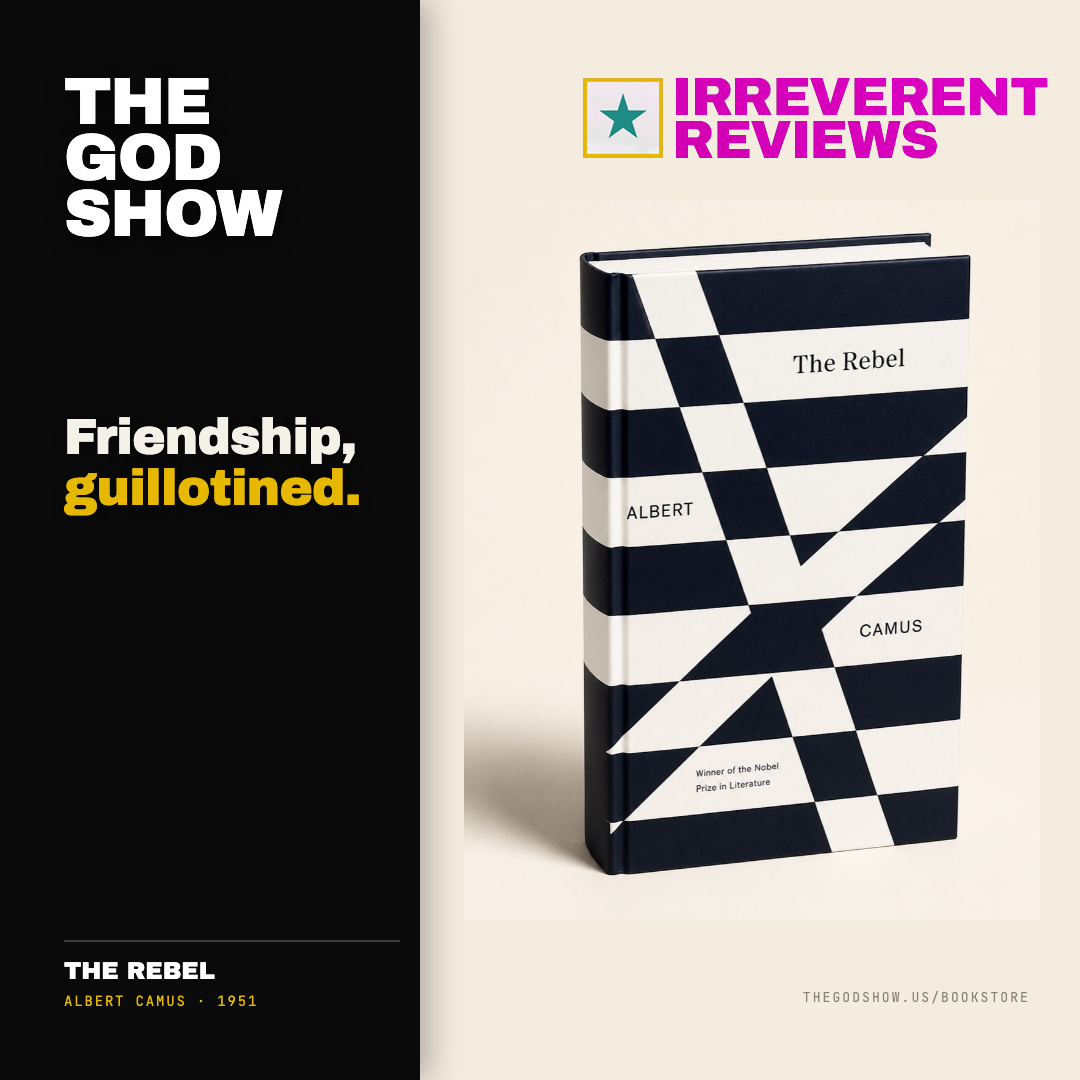
The Rebel
Albert Camus · 1951
The essay that asked why revolutions keep eating their children — and got Camus excommunicated from the Left Bank by his best friend's magazine.
Buy on Amazon →In 1951 Camus published a three-hundred-page autopsy of revolution — an attempt to explain, with full receipts, why two centuries of movements that began by demanding justice kept ending with execution schedules. The Rebel cost him his health (he wrote through tuberculosis relapses), his standing on the Left Bank, and the most famous friendship in twentieth-century thought. As collateral damage goes, the book got off light. Everyone else just lost an illusion.
From Prometheus to the Politburo
The argument moves like a detective working a two-century crime scene. Rebellion, for Camus, is the moment a slave says no — and inside that no hides a yes: there is a line, something in every human that must not be crossed. He flips Descartes for the age of the camps: not I think, therefore I am, but rebellion is what proves we exist — and proves it in the plural. Then he tracks the hijacking. Metaphysical rebels — Sade, the dandies, Ivan Karamazov, Nietzsche — declare war on creation itself; historical rebels — Saint-Just, the Hegelians, Lenin — crown History the new god, and History always needs one more corpse before payday. The moment a revolution accepts murder as administration, it has betrayed the rebellion that birthed it. Limits are not a betrayal of the cause. Limits are the cause.
The Duel at Les Temps Modernes
Then the literary assassination. Sartre's journal sat on the book for months — awkward, since author and editor were famous friends — before handing the review to a junior, Francis Jeanson, who shredded it as high-minded moralism with the politics of a chaplain. Camus, wounded and grand, replied over Jeanson's head with a stiff letter addressed to the Editor, as though Sartre were a stranger. Sartre's reply remains the most elegant cruelty in French letters: it opens by mourning the friendship it is about to execute, then spends twenty pages on the vivisection — the pomposity, the portable pedestal, the schoolmaster's morality, the suggestion that Camus had quit history and was reviewing it from the stands. Beneath the style points sat one real question: whether to say, out loud, that the Soviet camps were camps. Camus said name them. Much of the Left Bank preferred tact in front of the class enemy. Camus lost the friends and won the argument.
The Scoreboard, Seventy Years On
History graded the quarrel brutally. Budapest 1956, Prague 1968, Solzhenitsyn's testimony, 1989 — every decade filed another exhibit for Camus's side, while Sartre's fellow-traveling years became the thing his admirers explain around. The Rebel itself is not flawless: baggy in the German-philosophy chapters, professorial about poets — the Lautréamont section had already enraged André Breton in a separate feud, because Camus collected enemies the way other men collect stamps. But the central claim has not aged a day. In 2026, any movement that begins with a just no and ends up administering loyalty tests and show trials is rerunning a chapter of this book, usually without having read it.
“Camus lost the friends and won the argument.”
Verdict
Camus asked for a politics of limits — rebellion that remembers the human being it set out to defend — and the smartest room in Europe jeered. The room was wrong. He spent the rest of his short life paying for this book, and the book has spent seventy years collecting. Pour something Algerian and raise it to the most expensive no in modern thought — still cheaper than the alternative, every single time.