













Irreverent Reviews
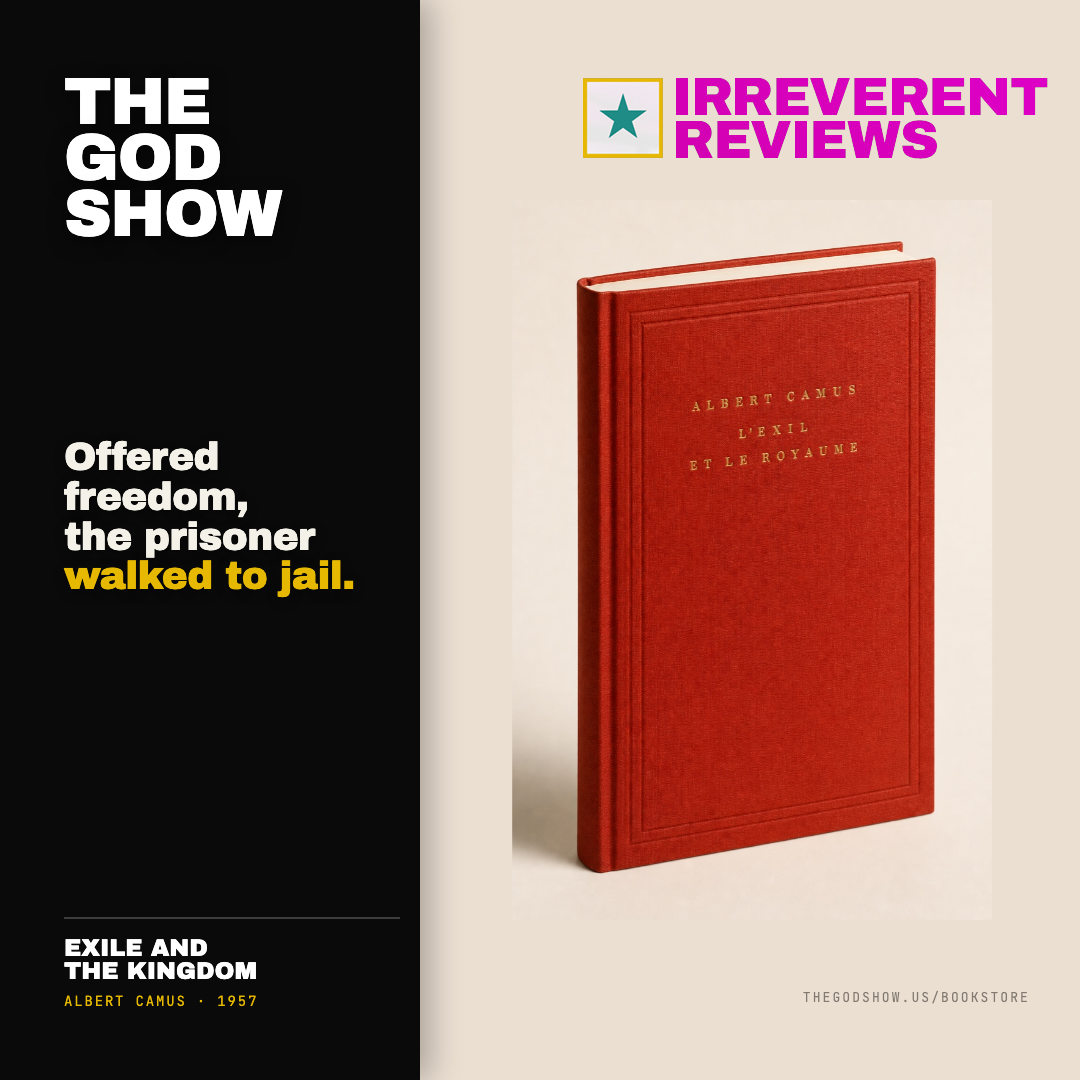
Exile and the Kingdom
Albert Camus · 1957
Six stories from the year of his Nobel: desert eros, a tongueless missionary, and the kindest man in Algeria condemned by both sides before sunset.
Buy on Amazon →The last fiction Camus published before the Facel Vega met the tree is, sneakily, his warmest book: six stories written while Algeria — his Algeria, the one in his bloodstream — burned toward independence and Paris demanded he pick a slogan. Everyone here is stranded between worlds: a wife, a schoolteacher, a renegade missionary, a painter, striking coopers, an engineer in Brazil. The Fall actually began as a story for this collection and outgrew it like a tumor; what stayed behind is quieter and, in its way, just as merciless. Every kingdom here sits ten minutes from a betrayal.
Desert Eros and a Missing Tongue
The opener, The Adulterous Woman, commits its adultery with no man at all: Janine, middle-aged, trailing her cloth-salesman husband through dusty market towns, slips out at night to a fort terrace and gives herself to the Saharan sky — cold, wind, wheeling stars — in the only scene Camus ever wrote that reads as pure eros. Her lover is the universe; the marriage never finds out. Then the whiplash of The Renegade: a delirious monologue by a missionary who marched into the salt city of Taghasa to convert the cruel and got converted by cruelty instead — tongue cut out, soul annexed, now crouched with a rifle waiting to ambush his own replacement. Faith, it turns out, can be colonized like anything else.
The Guest: Algeria in Twenty Pages
The masterpiece is The Guest — L'Hôte in French, which means both host and guest, the whole tragedy preloaded in the title. Daru, a schoolteacher alone on a high plateau, is ordered to deliver an Arab prisoner to colonial justice. He refuses to be a jailer: feeds the man, lets him sleep unguarded, walks him to a fork in the road, hands him money, and gives him the choice — east to prison, south to the nomads and freedom. The prisoner, for reasons the story is too honest to explain, takes the road to prison. Daru comes home to a threat chalked on his own blackboard, promising he will pay for handing over their brother. He helped no empire and saved no one, and both sides convicted him by nightfall. That was Camus's own seat in Algeria, 1957, rendered without one sentence of editorial.
Solitary, Solidary, Pick a Vowel
The confession hiding in the back is Jonas, or the Artist at Work: a painter whose star rises until his flat fills with disciples, critics, and obligations, and whose art quietly suffocates in the crowd. He ends up on a scaffold near his own ceiling with a canvas bearing one word that might read solitaire or solidaire — solitary or in solidarity — and Camus, freshly Nobeled at forty-four and being torn apart over Algeria, declines to say which letter is missing. In 2026, Jonas's flat is every creator's apartment: the audience moved in, the work died of exposure, and the one-word canvas is a bio torn between artist and community. Camus diagnosed the influencer economy from 1957; he just had the decency to set it in a garret.
“Every kingdom here sits ten minutes from a betrayal.”
Verdict
Exile and the Kingdom sold fewer copies than its famous siblings and outwrites most of them sentence for sentence — Camus with the volume down, working in watercolor instead of manifesto. The kingdom, every story whispers, is real: the night sky, the shared work, the freely given choice. It is just only visible from exile, and the border never stays open. Raise a glass at the fork in the road — to everyone who chose wrong for the right reasons.