














Irreverent Reviews
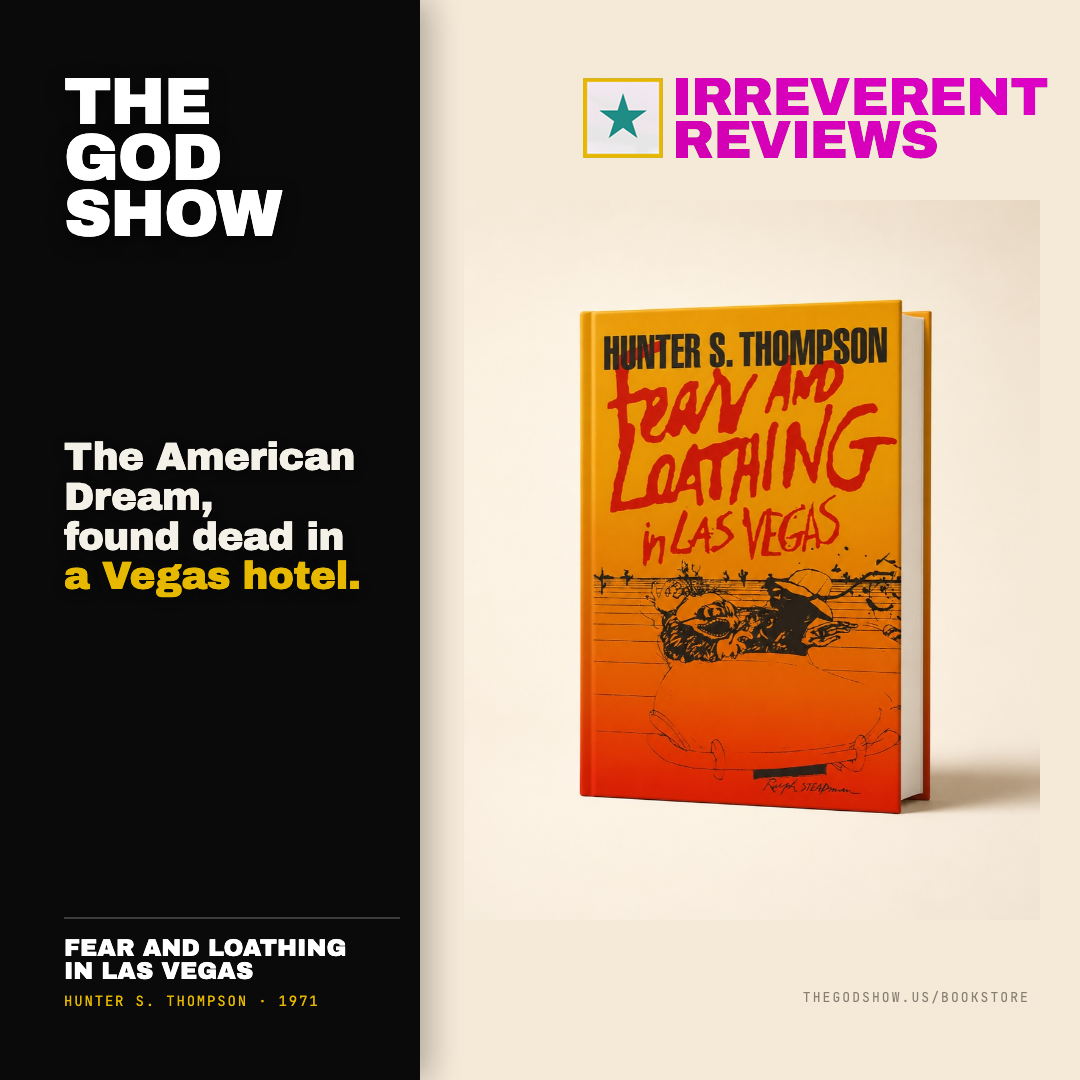
Fear and Loathing in Las Vegas
Hunter S. Thompson · 1971
A rented convertible, a Samoan attorney, a trunkful of controlled substances, and the funniest funeral the American Dream ever received.
Buy on Amazon →The assignment was a caption: Sports Illustrated wanted a couple hundred words on a motorcycle race in the desert. Hunter S. Thompson came back with the most savage spiritual document in American letters — two trips to Las Vegas with his attorney, the Chicano activist lawyer Oscar Zeta Acosta, lightly disguised as a three-hundred-pound Samoan, a convertible full of controlled substances, and a subtitle that gives the whole con away: a savage journey to the heart of the American Dream. Strip off the drugs and the chassis underneath is a pilgrimage — two broken believers driving into the desert to find out where the holy fire went.
Pilgrims at the Neon Shrine
Read it as religious travelogue and every set piece clicks. Vegas is the one American city that admits what the national religion actually worships, and Thompson treats its casinos like cathedrals built by the winning heresy — Circus-Circus alone, with trapeze acts wheeling above the blackjack tables, gets anatomized like a fresco of the national id, complete with a two-drink minimum. The pilgrims commit sacrilege at every station, terrorize the money-changers, and gatecrash a national convention of district attorneys who have gathered to explain drugs to one another — the book's best joke before you even reach the prose. And when they finally ask directions to the American Dream itself, the trail dead-ends at a torched nightclub on the edge of town. The Dream was a nightclub that burned down, which is the most honest theology America produced that decade.
The Sermon in the Middle
Buried in the chaos is the wave speech, the passage that justifies the entire carnival: a few suddenly sober paragraphs remembering the mid-sixties in San Francisco, when a generation believed — really believed — that consciousness itself was cresting, that the old order would simply be outgrown without a fight. Then the wave broke. Thompson stands in 1971 and reports that with the right kind of eyes you can almost see the high-water mark, the line where all that energy stalled and rolled back. It is the finest elegy the sixties ever received, and it is delivered by a man hiding from hotel security. In 2026 the pilgrimage still runs nightly — the ether is an edible now, the Dream takes Apple Pay, and the high-water mark has not moved an inch.
“The Dream was a nightclub that burned down, which is the most honest theology America produced that decade.”
Verdict
Gonzo journalism gets remembered as permission to be wasted on the job, which is the wrong lesson. Fear and Loathing endures because underneath the lizard hallucinations is a moralist with a broken heart, filing the obituary for the last American religious revival from inside its most expensive funeral home. The prose is a controlled burn and the grief is completely real. He bought the ticket and took the ride — the least you can do is read the report.