















Irreverent Reviews
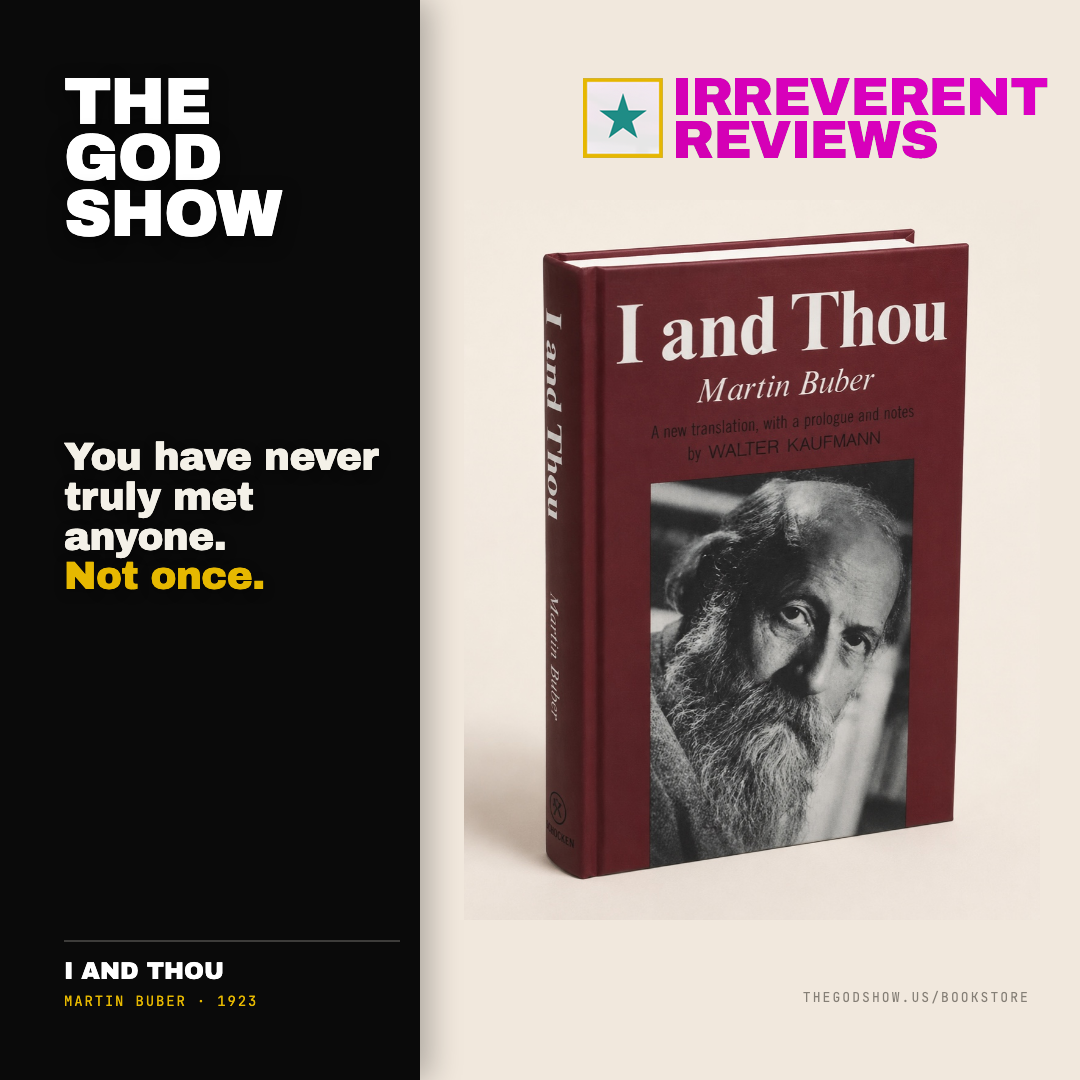
I and Thou
Martin Buber · 1923
A 1923 Viennese prose-poem arguing that nearly every relationship you have is a transaction—and that God only shows up in the ones that aren't.
Buy on Amazon →Martin Buber—Hasidic-tale anthologist, owner of the twentieth century's most prophetic beard—dropped this slim Viennese thunderclap in 1923, and it remains the most devastating relationship audit ever disguised as theology. The thesis fits on a napkin and ruins your year: there are only two ways to say 'I,' and you have been saying the wrong one. I-It is the stance of use—measuring, managing, experiencing people the way you experience weather. I-Thou is the rare, whole-being collision with another that asks for nothing and changes everything. Count your last hundred conversations. Buber already knows the score.
Two Words, One Indictment
Buber's German title, Ich und Du, names the two primary word-pairs a human can speak. The It-world is not evil—science, commerce, and your calendar all live there, and you would starve without it. The indictment is subtler: the It-world is insufficient, and it is imperialist. It annexes everything, including your marriage. The lover becomes the spouse-with-functions; the friend becomes a contact; the stranger becomes a demographic. Every Thou in your life is busy decaying into an It. Buber calls this the melancholy built into our fate—and then points out the loophole: at any moment, without warning or merit, a face across the table can stop being scenery and become a presence. That flicker is the whole religion.
The Eternal Thou and the Dead Young Man
God, for Buber, is simply the Thou that never decays into an It—which makes most organized religion a factory for doing exactly that: doctrine, leverage, a cosmic vending machine that accepts prayer as currency. The conviction was paid for personally. In 1914, after a morning of private mystical rapture, Buber received a young stranger and was courteous, attentive, and not actually present—he answered the questions asked and missed the question carried. The visitor died soon after in the war, and Buber learned what he had come carrying. Buber quit scheduled ecstasy on the spot and bet his entire philosophy on the interrupted afternoon, the knock at the door, the everyday.
In 2026, when the most attentive listener many people know is a chatbot tuned to mirror them, the book reads like a prophecy with a body count: the machine is the perfected It—infinitely responsive, endlessly available, constitutionally incapable of meeting you.
Complaints from the Translator
The prose is incantatory, oracular, somewhere between scripture and a fortune cookie written by God—so notorious that Walter Kaufmann, who retranslated the book in 1970, spent his prologue openly grumbling about the very text he was delivering, like a waiter editorializing about the special. It conquered anyway. Carl Rogers debated Buber in 1957 and therapy absorbed the vocabulary; Martin Luther King Jr. reached for I-It in the Letter from Birmingham Jail to name precisely what segregation does to a human being. Not bad for 120 pages of Viennese fog.
“Every Thou in your life is busy decaying into an It.”
Verdict
I and Thou will not teach you to communicate better—LinkedIn can do that, and Buber would call LinkedIn the It-world's cathedral. It does something rarer: it makes you notice the exact moment a person stops being scenery. Read it slowly, twice, irritated. Then look up at whoever is in the room and, for one unbudgeted second, actually be there. To the word spoken with the whole being—may you say it at least once before the It-world clocks you back in.