



































































Irreverent Reviews
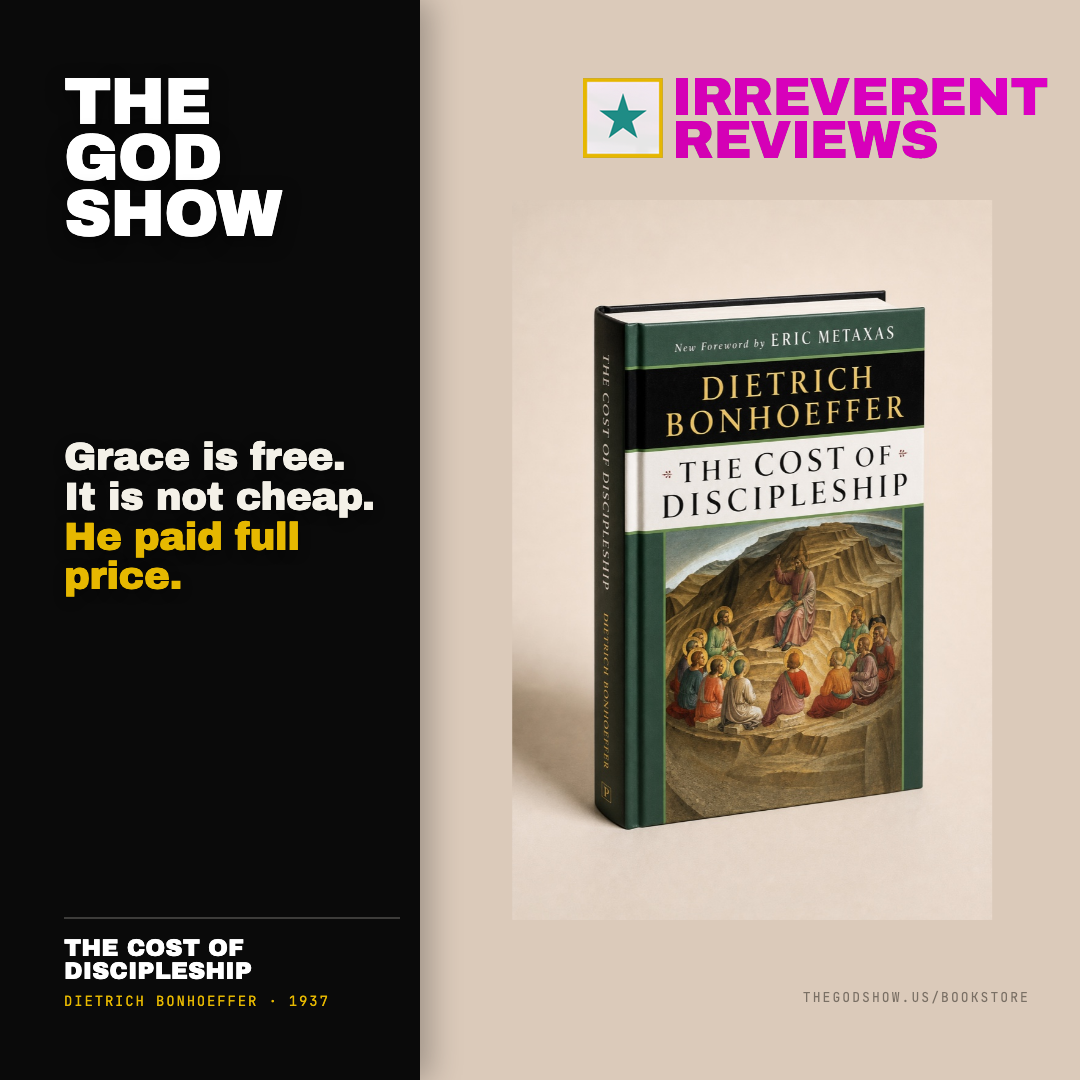
The Cost of Discipleship
Dietrich Bonhoeffer · 1937
Written at 31 while running an illegal seminary under the Gestapo's nose—the century's most credible takedown of forgiveness as a subscription perk.
Buy on Amazon →Dietrich Bonhoeffer was twenty-seven when the German national church put on a swastika, and unlike most of his colleagues he noticed immediately. The Berlin prodigy—doctorate at twenty-one, celebrity-psychiatrist father, piano skills serious enough that the family briefly assumed music would be the career—spent the mid-1930s running an illegal seminary in the Pomeranian backwoods, training pastors for the dissident Confessing Church after the official one had been absorbed by the Reich. Out of that came Nachfolge, published in English as The Cost of Discipleship: his sustained assault on what he called cheap grace—forgiveness with the price tag torn off, comfort sold as a birthright, while the country armed for the abyss. It is not a subtle book. Subtlety had stopped working.
Grace at Clearance Prices
Cheap grace, in Bonhoeffer's anatomy, is grace as inventory: absolution without repentance, baptism without obedience, communion without confession, doctrine swallowed whole so that nothing in particular is ever required of anyone. It is the loyalty program a state church offers a nation it has decided not to bother. Costly grace, the real article, costs your life—the call to follow is, in his framing, an invitation to come and die, and he turned out to be the rare author for whom that sentence was a logistics memo rather than a metaphor. The core of the book is a long, merciless reading of the Sermon on the Mount with the laugh track off: Jesus meant it, all of it, including the part about loving enemies—a clause with obvious local applications in the Germany of 1937.
Harlem, the Last Boat, and the Bill
The biography is the book's collateral. In 1930 Bonhoeffer spent a fellowship year at Union Seminary in New York, found the American theology thin, and got taken apart in the best way at Abyssinian Baptist Church in Harlem, where he heard the faith sung by people it had actually cost something; he hauled a stack of spirituals records back to Berlin like contraband. In 1939, with war coming, American friends engineered his escape to New York. He lasted under a month, then sailed home weeks before the Atlantic closed, reasoning that he would forfeit any right to Germany's reconstruction if he sat out its catastrophe. He joined military intelligence as a double agent, helped smuggle Jews into Switzerland, got engaged, and was arrested three months later. When the July 1944 plot against Hitler failed and the files surfaced, the account came due: Flossenburg concentration camp, April 9, 1945, two weeks before the Americans arrived.
The Most Hijacked Martyr in the Business
The afterlife has been its own comedy. Everyone wants Bonhoeffer on the roster: rival biographies tug him left and right, and a 'Bonhoeffer moment' now gets declared roughly every news cycle, usually by someone whose maximum personal exposure is a rough afternoon online. In 2026, the man who defined costly grace is most often quoted by people enjoying the bulk discount. He saw the danger himself: from prison he reread the book, admitted he could see its perils, and stood by it anyway—more self-audit than his fan club has ever attempted.
“It is not a subtle book. Subtlety had stopped working.”
Verdict
Plenty of books insist that faith should cost something. Exactly one modern author was billed in full and paid without renegotiating. The Cost of Discipleship is severe, repetitive, allergic to comfort, and underwritten by a gallows—which buys it a hearing that smoother books have not earned and cannot borrow. Read it slowly, resist casting yourself as the hero, and clock how fast your own grace goes on sale. Then raise a glass to Finkenwalde, class of 1937: the only seminary whose final exam was the twentieth century.