Irreverent Reviews
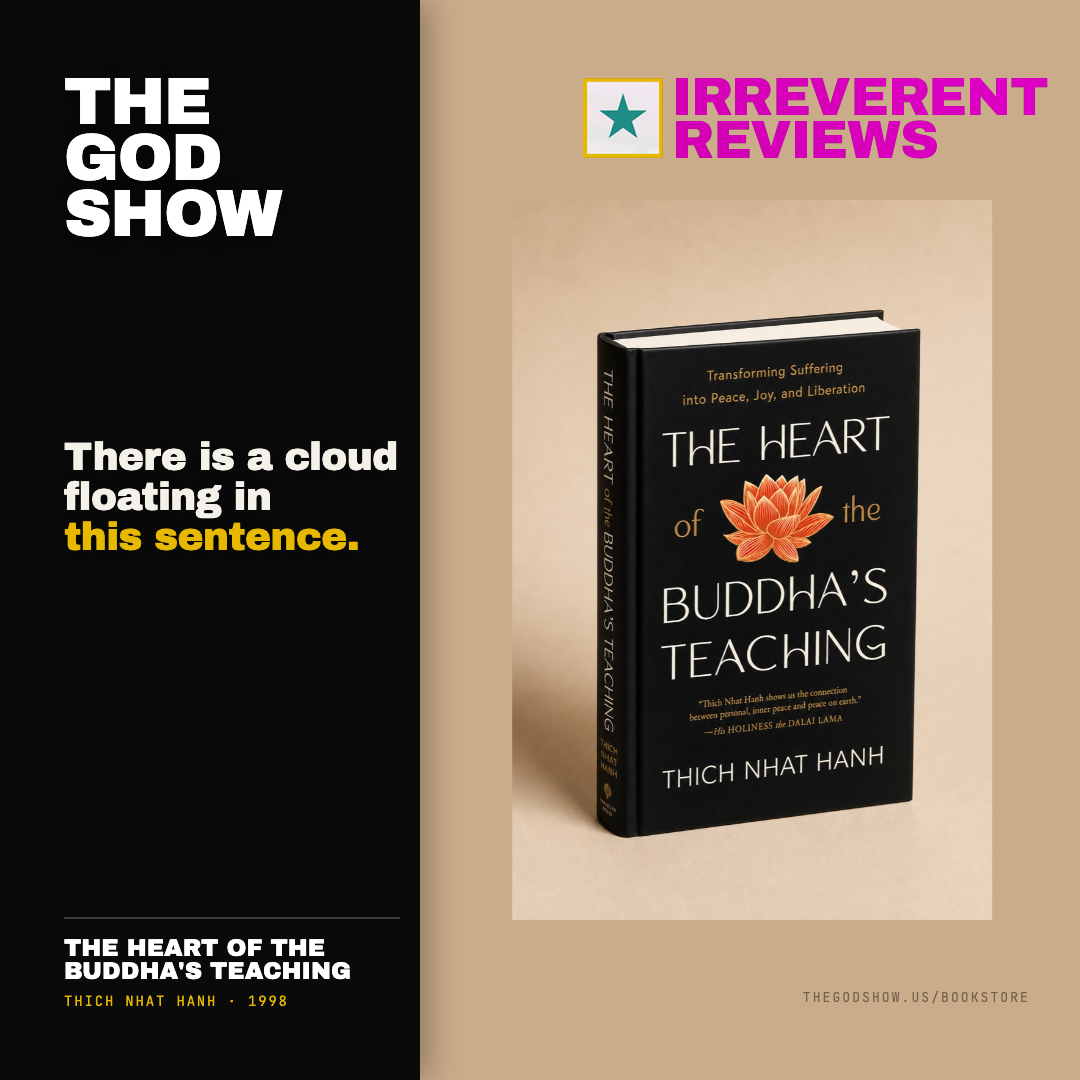
The Heart of the Buddha's Teaching
Thich Nhat Hanh · 1998
The exiled Vietnamese monk MLK nominated for a Nobel distills all of Buddhism into one volume—every truth, list, and breath, minus the migraine.
Buy on Amazon →Thich Nhat Hanh spent the Vietnam War founding a corps of young social workers who rebuilt bombed villages—some were murdered for it—then toured the West asking everyone to stop shooting, for which both Vietnams barred him from coming home. Martin Luther King Jr. broke protocol to nominate him publicly for the 1967 Nobel Peace Prize; the committee, in a flawless display of institutional courage, gave the prize to no one that year. Three decades into exile, the monk sat down and wrote this: the entire core curriculum of Buddhism in one volume, delivered so gently you barely notice it disassembling your operating system.
The Doctor Will See You Now
His first move is to fire Buddhism's worst publicist. 'Life is suffering' is, he insists, a slander built on lazy translation—the First Noble Truth names the illness precisely so it can be treated, and dwelling on the diagnosis while ignoring the cure does injustice to the whole tradition. The Buddha he presents works like a physician: symptom, cause, the scandalous claim that healing exists, and a prescription with eight refills. The Four Noble Truths are not a verdict; they are a treatment plan. Suffering, in his hands, is not the opposite of happiness but its raw material—the gardener's secret: compost in, flowers out.
There Is a Cloud in Your Paper
Then the signature demonstration: look at a sheet of paper until you see the cloud in it. No cloud, no rain; no rain, no tree; no tree, no paper. The dictionary had no word for what everything is constantly doing to everything else, so he coined one—interbeing—and hung the whole book on it. From there he walks the great numbered lists—Five Aggregates, Seven Factors, Twelve Links—Buddhism's filing cabinet, the world's most enlightened bureaucracy, and he is the rare teacher who opens every drawer without making it feel like accounting. Each list lands as something you can do with your next breath, which was, he would note, the only breath ever available.
Engaged, Not Curated
He coined Engaged Buddhism too: meditation that walks into the burning village instead of scheduling around it. In 2026, mindfulness is mostly a productivity garnish—an app between meetings, four deep breaths before the quarterly review—and this book stands there, politely, insisting that awareness was never meant to optimize your output. It was meant to make you incapable of ignoring other people's pain. The distance between those two projects is the distance between an amenity and a religion.
“The Four Noble Truths are not a verdict; they are a treatment plan.”
Verdict
He went home at last in 2018, to the Hue temple where he had ordained at sixteen, and died there in 2022, having outlived the war, the bans, and several of the governments that exiled him. The book remains the gold-standard syllabus, taught by the man who earned his calm the hardest way available. Read it slowly. Water the good seeds. And when life hands you garbage, think like his gardener—that is not an insult; that is flowers, eventually.