








































Irreverent Reviews
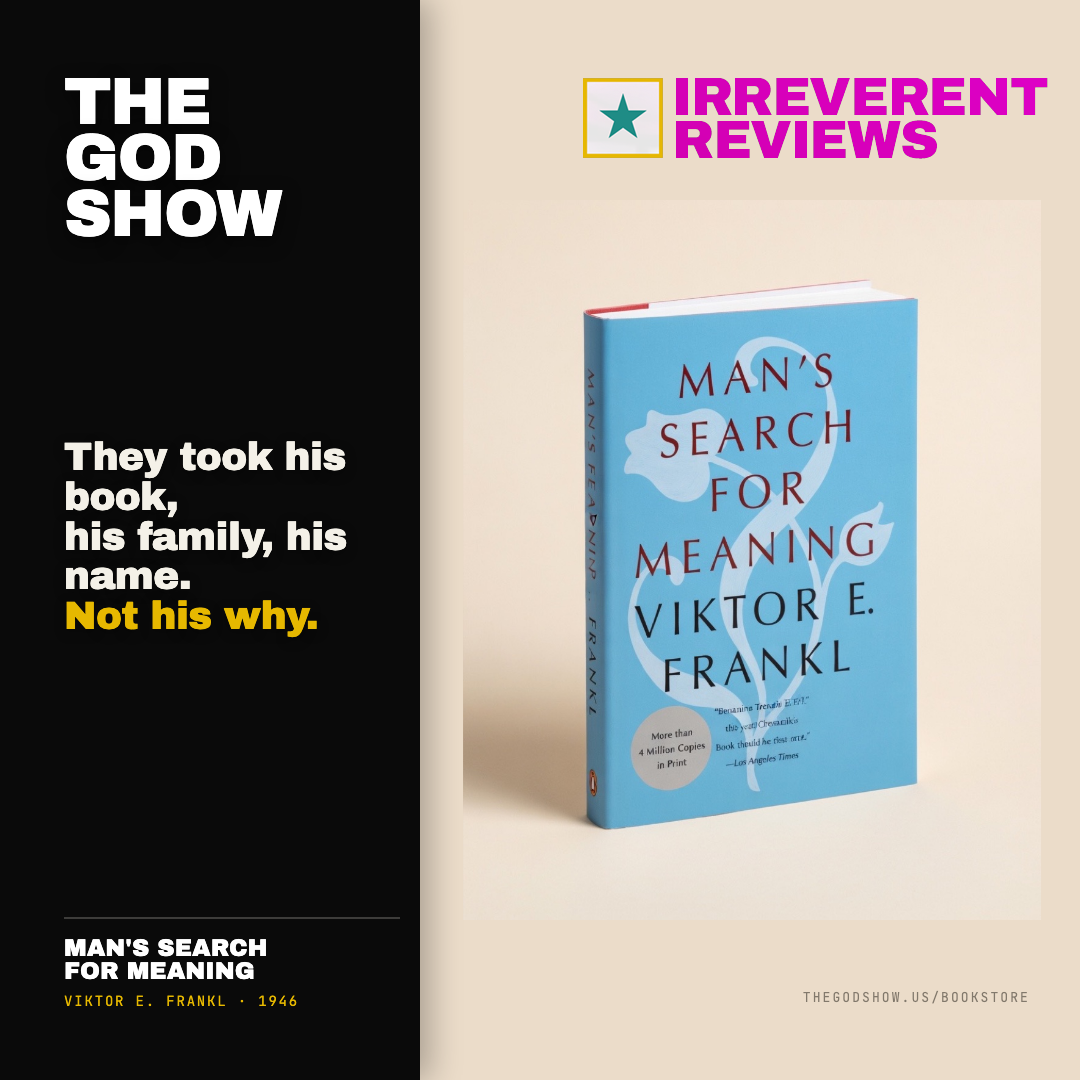
Man's Search for Meaning
Viktor E. Frankl · 1946
Dictated in nine days, intended to be anonymous, sold over ten million copies: psychiatry's most unlikely bestseller began as field notes from the bottom of history.
Buy on Amazon →In 1941 Viktor Frankl held an American visa and a way out of Vienna. As he told it, he saw the fragment of a synagogue tablet his father had salvaged — the commandment about honoring your father and mother — and let the visa lapse. What followed: Theresienstadt, Auschwitz, two camps in the Dachau system, typhus, and the deaths of his wife, mother, father, and brother. In 1946 he dictated this book in nine days and tried to publish it anonymously; friends talked him out of it at the last moment. It went on to sell over ten million copies. It is not an inspirational book. It is testimony with a spine.
The Manuscript Sewn Into the Coat
Frankl arrived at Auschwitz with his life's work — the manuscript of his first book — stitched into the lining of his coat, and lost it in the first hour along with the coat. The reconstruction became a reason: gravely ill with typhus in a Bavarian subcamp, he scratched out its skeleton on scraps, including the backs of SS forms a fellow prisoner scrounged for his fortieth birthday. That is the book's method in miniature. Frankl the psychiatrist never stopped taking field notes on Frankl the prisoner, charting the stages he saw everywhere: first shock, then the gray apathy that anesthetizes, and then — among those who held on longest — some thread anchoring a person to a future: someone to find, work left unfinished. He is ruthlessly clear that survival was mostly luck, and he wrote plainly that the finest among them rarely came back. The honesty is what licenses everything else.
Freud Says Pleasure. Adler Says Power. Frankl Says Why.
The book's second half lays out logotherapy, Vienna's so-called third school of psychotherapy: where Freud built us on the hunt for pleasure and Adler on the hunt for power, Frankl argued the primary human drive is meaning — and that it is found down exactly three roads: in work that is yours to do, in love, and, when a situation truly cannot be changed, in the stance you take toward it. That last road is the book's spine and its most-abused idea. Frankl is not saying suffering is secretly good; he despised that reading. He is saying that when everything else has been stripped away, the one thing that cannot be confiscated is your answer to what happens to you. He watched the proof walk past him daily, in both directions.
Purpose, Now in a Candle
The afterlife of the book is its own absurd chapter. A memoir its author wanted nameless became, by a famous Library of Congress survey, one of the most influential books in America — quoted at graduations, flattened into wall art. In 2026, purpose is a candle scent and a LinkedIn banner, and a man who located meaning in a typhus barracks gets paraphrased by productivity apps selling morning routines. Some scholars wince at any uplift wrung from the camps, and Frankl took the objection seriously; his defense was that he was not selling consolation, he was reporting an observation. He also kept personal receipts against despair: he remarried, climbed mountains into his sixties, and earned a pilot's license at sixty-seven, as if to log, officially, that the future he prescribed was one he also took.
“It is not an inspirational book. It is testimony with a spine.”
Verdict
Read it in one sitting, because that is how it was made, and skip nothing. Then notice what it never once asks of you: optimism, forgiveness, a silver lining. It asks only the question, aimed at your one unrepeatable life, that no algorithm can answer on your behalf. No toast feels equal to it, so keep it simple and stand up straighter: to the why that outlives every how.