





























Irreverent Reviews
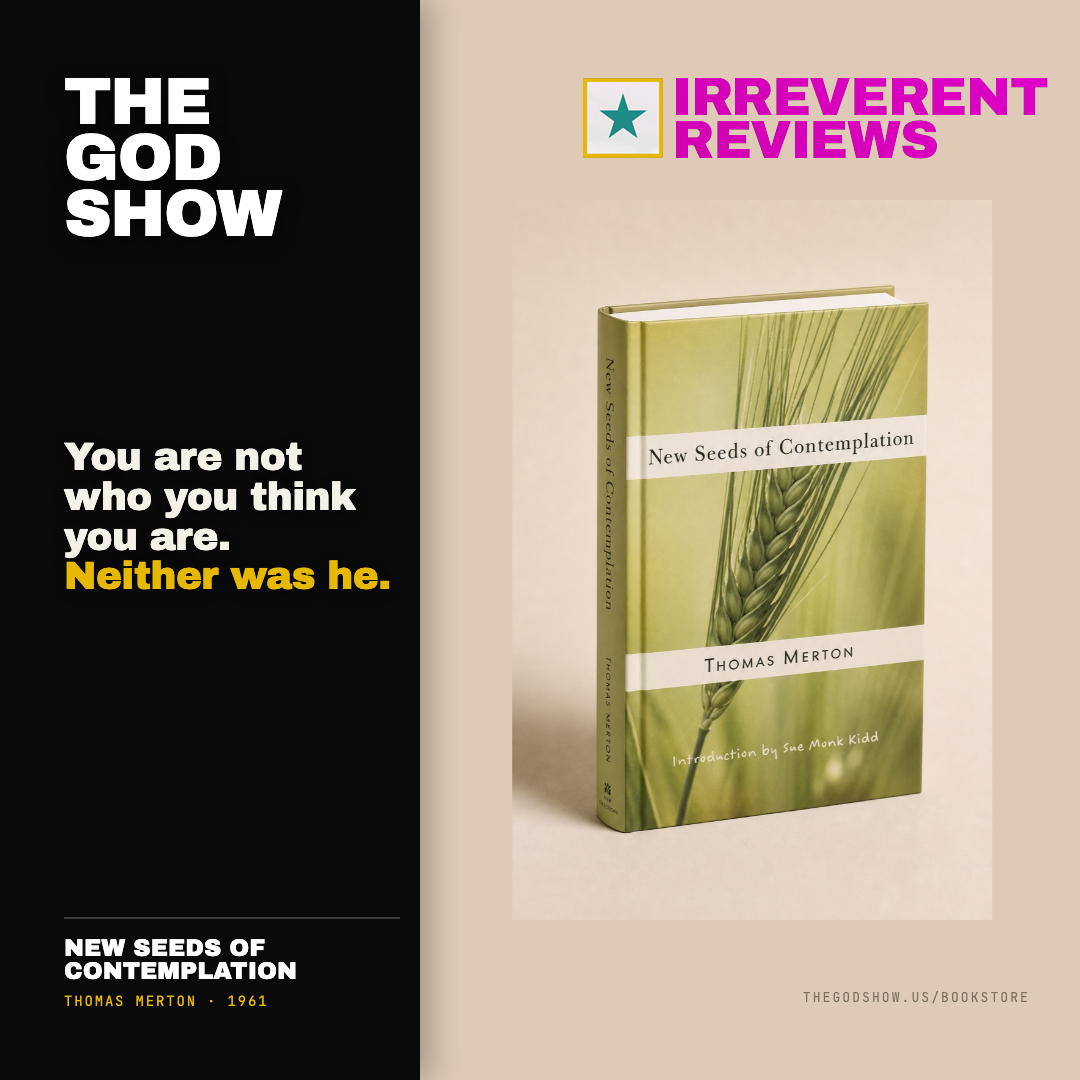
New Seeds of Contemplation
Thomas Merton · 1961
America's most famous silent monk rewrote his own classic to correct its smugness—then explained why the self on your business card is a forgery.
Buy on Amazon →Thomas Merton signed up for the most extreme privacy regime in Western religion and became a celebrity anyway, which is exactly the kind of joke his theology predicts. The Trappist of Gethsemani, Kentucky—a man who left Cambridge trailing a paternity scandal, partied through Columbia, and entered the monastery days after Pearl Harbor—wrote a 1948 memoir that sold in the hundreds of thousands and made him the most famous quiet person in America. His order restricted speech; his abbot ordered him to keep writing. New Seeds of Contemplation, from 1961, is the mid-career correction: a top-to-bottom rewrite of his own 1949 classic, undertaken because the younger Merton had come to strike the older Merton as insufferably sure of himself. Imagine a bestselling author issuing a recall notice on his own personality. That is this book.
Your Personality Is a Forgery
The engine of the book is the split between the true self and the false self, and the false self is the one reading this: the public-relations construct made of achievements, opinions, grievances, and taste, wrapped in experiences like bandages so it looks solid from the street. Merton's claim is that most human misery comes from defending this construct, precisely because some buried part of you suspects there is nobody under the bandages. The true self, hidden in God, cannot be observed, compared, or marketed—which is inconvenient, since marketing is the only skill the false self has. He wrote this in 1961, decades before anyone said personal brand. In 2026, with every human being running a small media company from a phone, the chapter reads less like mysticism and more like a system diagnostic.
Contemplation Is Not a Deliverable
The second demolition targets spiritual achievers. Contemplation, Merton insists, is not a technique, a trance, or a merit badge; it cannot be scheduled, optimized, or seized by effort, because the effort drags the false self into the prayer room with you. He reserves special contempt for collectors—people who hoard retreats, methods, and exotic experiences like frequent-flyer miles, mistaking the souvenirs for the journey. A cloistered monk informing type-A seekers that trying harder is the disease remains one of the great pieces of counter-programming in religious literature, and the wellness industry has spent sixty years proving him right by selling the cure in twelve modules.
The Punchline He Didn't Write
Merton stayed messy, which is why he stays trustworthy. His order's censors muzzled his anti-war writing; he circulated it in mimeograph anyway. At fifty-one, hospitalized in Louisville, he fell catastrophically in love with a student nurse, agonized in his journals, chose the monastery—and left instructions that the journals could eventually be published anyway, love story and all, declining to curate his own myth. In 1968 he finally got permission to travel, gave a morning talk to monks in Bangkok, went back to his room, and was killed by a badly wired electric fan—twenty-seven years to the day after he entered Gethsemani. The body of America's most prominent anti-war monk flew home on a US military transport alongside soldiers killed in Vietnam. He would have noted the irony, and then the grace, in that order.
“Imagine a bestselling author issuing a recall notice on his own personality.”
Verdict
New Seeds is the rare spiritual book that gets more accurate as the world gets louder—written for monks, aimed, it turns out, at the entire attention economy. Read three pages a night and feel the scaffolding of your personality creak. Merton was a contradiction in a cowl: silent and famous, solitary and lovesick, a pacifist shipped home with the war dead. That is not the scandal; that is the credential. Only a man at war with his own false self could map yours this precisely. To the self you have been performing: may it rest in peace while you are still alive.