






























































Irreverent Reviews
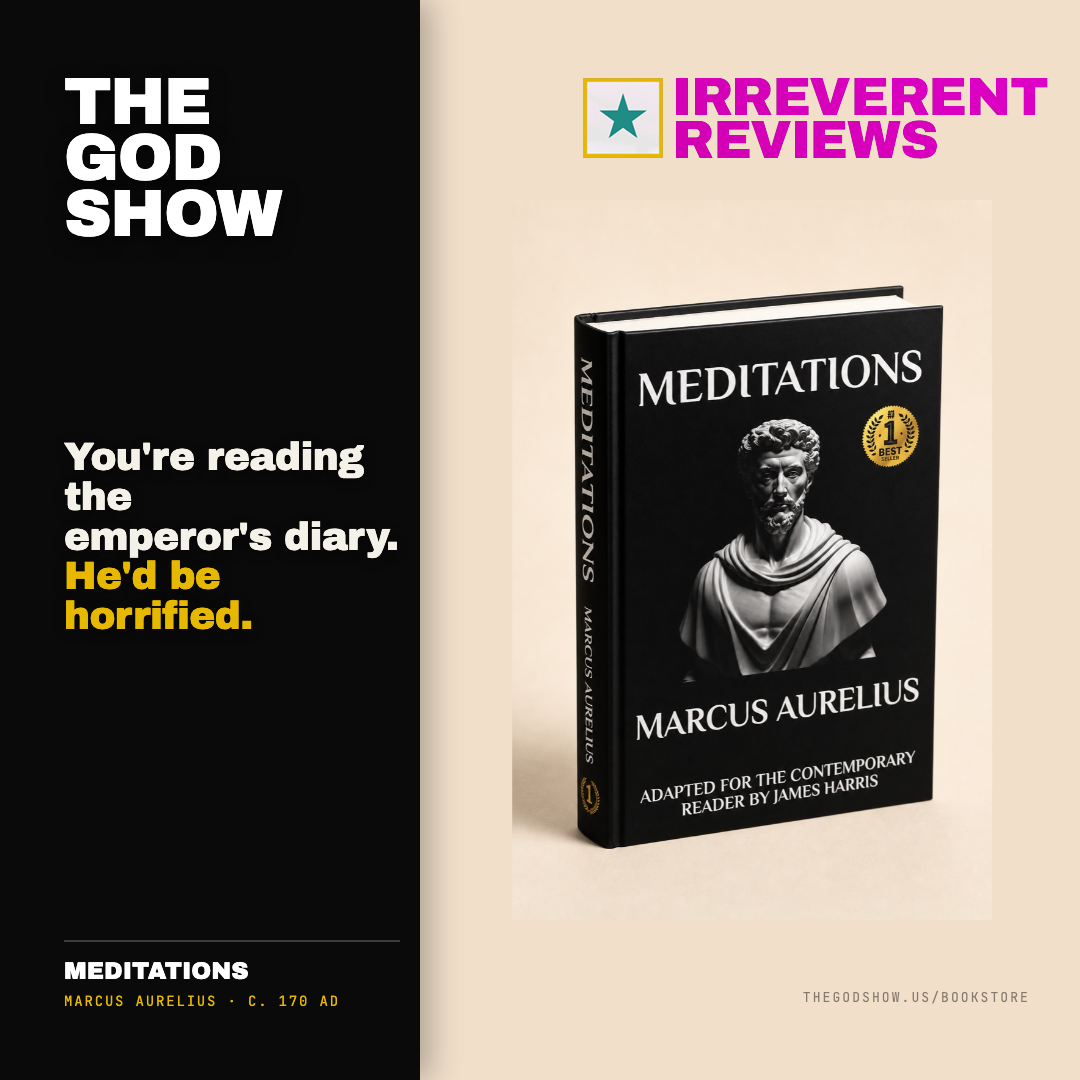
Meditations
Marcus Aurelius · c. 170 AD
Plague outside, barbarians at the river, a son going wrong — the philosopher-king coped by journaling in Greek, never suspecting he was drafting a bestseller.
Buy on Amazon →Marcus Aurelius ran the Roman Empire at its absolute worst moment — plague carrying off millions, Germanic tribes pressing the Danube, a treasury so strapped he auctioned palace furniture — and his response, at night, in a military tent, was to write himself stern little notes in Greek. He called them nothing; later editors called them To Himself; we call them Meditations. They were never meant for publication, which is precisely why they work. There is no posing in this book because there was no audience. You are reading the unguarded self-talk of the one human being on earth who could have anyone executed, and who mostly worried about staying polite at breakfast.
Journaling at the End of the World
Forget marble serenity. The notebooks were written between battles of the Marcomannic Wars while the Antonine plague did its work, by a man whose court physician, Galen, kept him supplied with theriac — a fashionable cure-all spiked with opium. The text survived antiquity by a thread, surfacing in scattered scholarly mentions and not reaching print until 1559; every gift-shop edition you have ever seen descends from a private document that escaped. Its most famous early passage steels the author to meet the meddling, the ungrateful, and the arrogant before lunch — not as satire, but as a checklist. He was rehearsing his own temper. The emperor of Rome required daily coaching to remain a functioning adult, which is the most reassuring fact antiquity has on file.
Reps for the Soul
Critics complain that the book repeats itself. Of course it repeats itself. You will die soon; everyone you admire and resent will die soon; fame is a relay race of forgettable people; do the task in front of you; you can endure the present moment. Again and again, in fresh phrasing, like sets at the gym. Meditations is not wisdom literature. It is a man doing reps on his own soul. The repetition is the philosophy — Stoicism for Marcus was not a theory to admire but a maintenance schedule, performed nightly, on the only equipment he actually controlled. In 2026 his private therapy notes are a hustle-culture aesthetic, stamped on tumblers and quoted by accounts run by men who would not last one Danube winter, and the strange thing is that the book survives even this.
The Punchline Named Commodus
Here is the gossip that keeps the book honest: the philosopher-king's heir was Commodus, who renamed Rome after himself and fought rigged gladiator bouts — proof that you can master your own soul and still lose the parenting lottery. Ancient rumor sniped at his wife Faustina; his beloved tutor Fronto wrote him letters of embarrassing tenderness; his co-emperor Lucius Verus handled the drinking for both of them. Marcus knew exactly how little of this was up to him, wrote it down, and went back to work.
“Meditations is not wisdom literature. It is a man doing reps on his own soul.”
Verdict
Read it ten minutes a night and ignore everyone selling you Marcus as a productivity hack — he was trying to be good, not efficient, and he considered the difference the whole game. He would be horrified that strangers are reading his diary. Strangers keep becoming slightly better people because of it. History has played far crueler jokes. To the emperor who talked to himself: may we all be this embarrassing in our drafts.