

















Irreverent Reviews
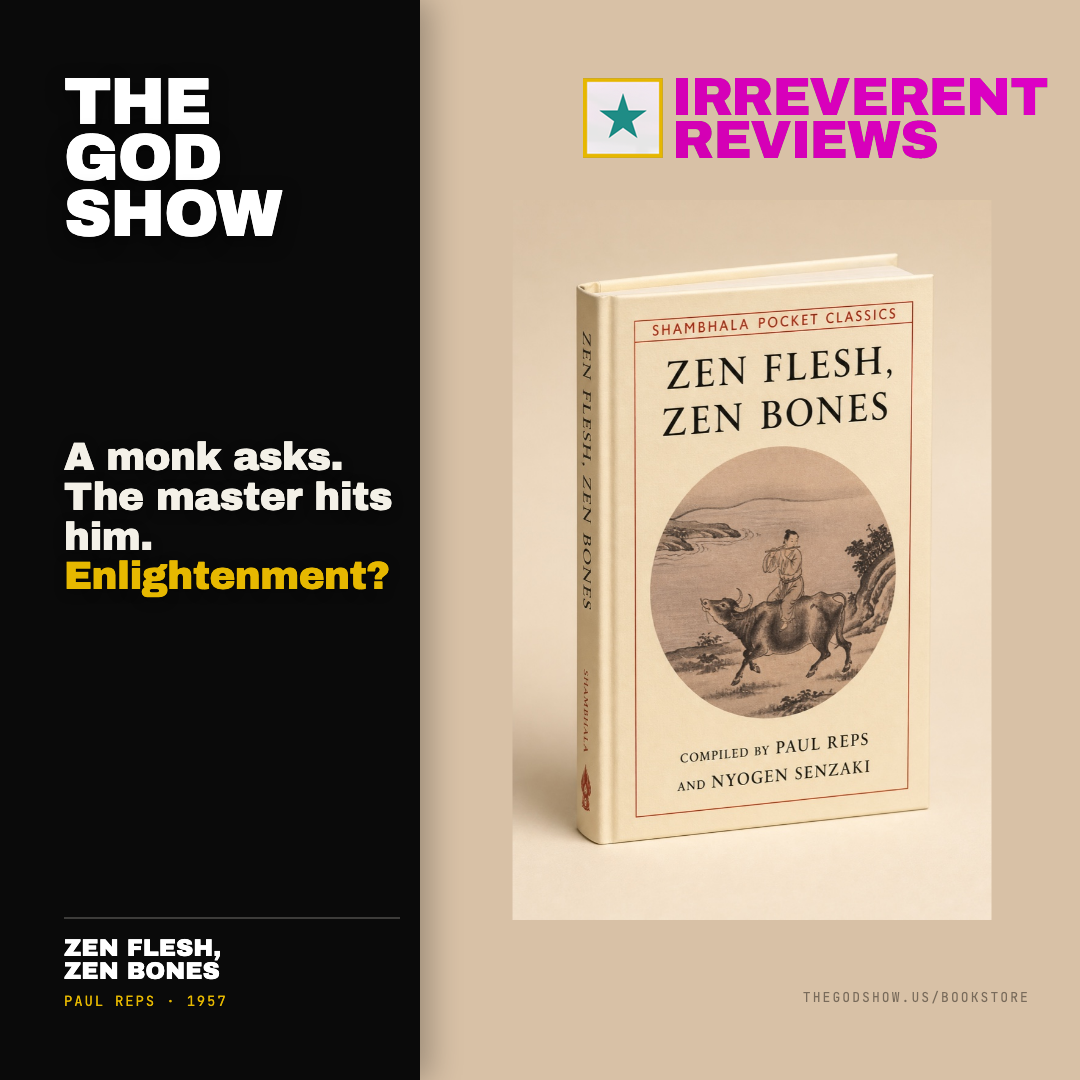
Zen Flesh, Zen Bones
Paul Reps · 1957
Four ancient Zen anthologies stapled into one pocket grenade and lobbed into 1957 America — the same year Kerouac hit the road.
Buy on Amazon →Paul Reps was an American haiku poet with a vaudeville sense of timing, and Nyogen Senzaki was a Japanese monk who billed himself as a homeless mushroom of a teacher, running Zen out of rented halls in California — when the U.S. government wasn't interning him at Heart Mountain. Together they stapled four ancient texts into one pocket-sized landmine and dropped it on 1957 America, the same year On the Road came out. The Beats inhaled it. So did everyone the Beats annoyed. Zen arrives as a sucker punch wrapped in a paper fan. This is the book that threw it.
Four Books, Zero Explanations
The anthology bolts together 101 Zen Stories, a collection of monks behaving unforgettably; The Gateless Gate, the thirteenth-century koan casebook of Mumon, including the most famous one-syllable answer in religious history — a master is asked whether a dog has Buddha-nature and replies with a word that works like a trapdoor; 10 Bulls, Kakuan's twelfth-century oxherding pictures, which render enlightenment as livestock management; and Centering, 112 meditation pointers from a Sanskrit tantra centuries older than Zen itself. Reps slid that last one in as a possible ancestor. Scholars have been clearing their throats about it ever since. Readers have never once cared.
The stories are the gateway drug. A university professor visits the master Nan-in to ask about Zen, and Nan-in pours his tea until the cup overflows — your mind is too full to receive anything, professor. The master Hakuin gets framed for fathering a village girl's baby, raises the child without protest, then hands it back with the same calm when the accusation collapses. Two traveling monks meet a girl stranded by a muddy road; one carries her across and walks on, while the other stews over the broken no-touching rule for hours — until the first points out that he set her down back at the road, and his brother monk is the one still carrying her.
The Koan Industrial Complex
A koan is not a riddle, because riddles have answers you can say at parties. It's a crowbar. The rational mind gets handed a question shaped like a paradox — the sound of one hand, your face before your parents were born — and pries at it until the prying mechanism itself cracks. That is the point. The shout, the slap, the non sequitur about a tree in the garden: pedagogy by ambush. In 2026, when every question on earth gets an instant machine-generated answer, the koan stands alone as the question engineered to break the answering machine. It has no use for your fluency. It wants the moment after fluency fails.
“Zen arrives as a sucker punch wrapped in a paper fan.”
Verdict
Zen Flesh, Zen Bones is small enough for a jacket pocket and has the blast radius of a much larger book. Sixty-odd years of American Zen — the centers, the cushions, the corporate mindfulness retreats — trace back through this paperback like a fuse. Read one story a night and let it quietly ruin your sleep, or read it straight through and learn nothing, which may be the same achievement. Raise a teacup to Reps and Senzaki — and keep pouring after it overflows.