


























































Irreverent Reviews
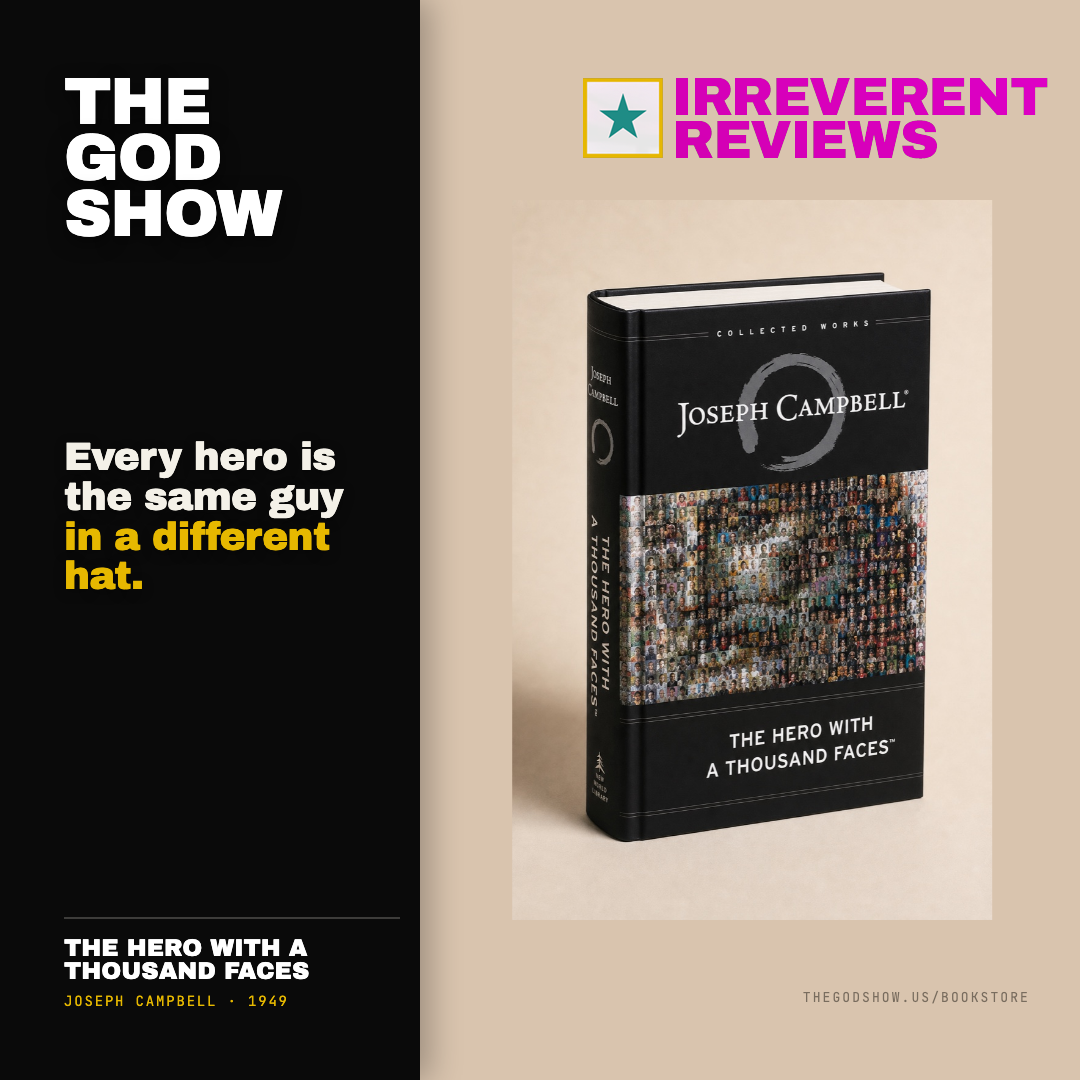
The Hero with a Thousand Faces
Joseph Campbell · 1949
Five Depression years reading nine hours a day in a Woodstock shack produced the skeleton key Hollywood now jams into every locked screenplay.
Buy on Amazon →Joseph Campbell spent the Depression unemployed in a Woodstock cabin, reading mythology nine hours a day for five years—either a call to adventure or a cautionary tale, depending on your mother. What emerged in 1949 was The Hero with a Thousand Faces and one audacious claim: beneath Gilgamesh, the Buddha, Moses, Maui, and a thousand campfire variants runs a single repeating story. He called it the monomyth, a word he shoplifted from Finnegans Wake, a book he had already co-written a reader's guide to. Departure, initiation, return: a nobody gets the call, refuses it, gets dragged across the threshold, dies a little in the belly of something, seizes the prize, and limps home transformed. Sound familiar? It is the plot of roughly everything in your queue, and this book is the reason.
The Pattern Under the Floorboards
The machinery is seductive: seventeen stages, from the call to adventure through supernatural aid, threshold guardians, the road of trials, atonement with the father, the boon, and the awkward business of coming home. Campbell built it from Frazer's comparative anthropology and a heavy mortgage from Jung—archetypes, the collective unconscious, the hero's journey as the psyche's growth chart projected onto the night sky. His running suggestion that myths are the dreams a culture has in public remains genuinely profound, and the prose toggles between professor and carnival barker, often inside one sentence. Campbell was never a member of the guild he raided—he taught undergraduates at Sarah Lawrence for thirty-eight years instead of fighting for tenure among the folklorists—which is exactly why the book reads like a heist: fast, thrilling, and conducted without permits.
The Folklorists Would Like a Word
The professionals have spent seventy years filing complaints, and the complaints are fair. The method is cherry-picking at industrial scale: keep the episodes that fit the arc, mulch the rest, flatten Polynesia, Galilee, and the Yukon into a single silhouette. If every myth is the same myth, you have stopped reading myths and started reading Campbell. And the hero is, structurally, a guy: women in this book serve mostly as temptresses, goddesses, or the prize at the end of the trail—a framing so airtight that later writers had to build an entire counter-genre just to get the heroine out of the trophy cabinet. None of it stopped the pattern from working. Wrong in the details, useful at scale: the most Hollywood sentence ever written about a scholar.
Skywalker Ranch Is the Return Threshold
The book sold quietly for a quarter century until a stuck young filmmaker named George Lucas used the monomyth to wrestle a space opera into shape, then spent decades saying so. Hollywood turned revelation into checklist: a Disney development memo boiled Campbell down to seven pages, the memo became a manual, the manual became the beat sheet, and the beat sheet became the load-bearing wall of every franchise you have ever half-watched. In 2026 the refusal of the call lands at minute twelve, on schedule, in four time zones at once. Campbell missed his own apotheosis—he died in 1987, months before the PBS interviews taped at Lucas's ranch made him a posthumous superstar and put follow-your-bliss on a million dorm walls. The myth machine ate the mythologist.
“If every myth is the same myth, you have stopped reading myths and started reading Campbell.”
Verdict
Read it to see the matrix: after Campbell you will clock the threshold crossing in everything from Exodus to whatever the algorithm serves tonight, and you will never unsee it. Then read one actual myth, slowly, untranslated by formula, to remember what gets mulched on the way to universal. Campbell found a real pattern; his heirs paved a planet with it. That is not entirely his fault, but the invoice has his name on it. To the man in the shack: you followed your bliss, and the rest of us are on the road of trials—streaming it, mostly, at 1.5x speed.