




























Irreverent Reviews
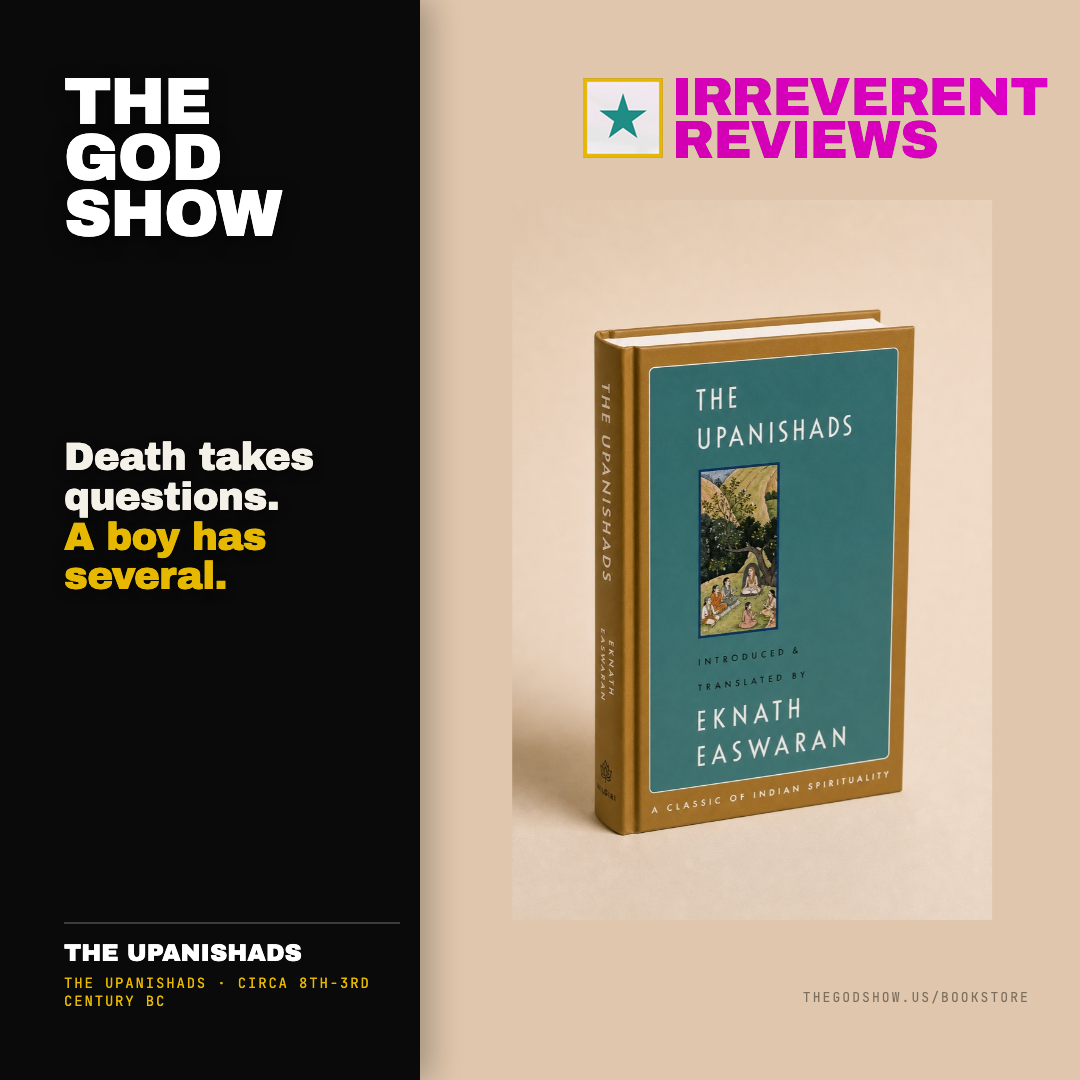
The Upanishads
The Upanishads · Circa 8th-3rd century BC
Anonymous forest sages worked out that the self is an inside job — three thousand years before anyone could bill you for the insight.
Buy on Amazon →The word upanishad means, roughly, sitting down close — at the teacher's feet, where the secret things finally get said out loud. Composed by anonymous forest sages between about the eighth and third centuries BC, at the tail end of the Vedas — hence Vedanta, the end of the Vedas — these texts mark the moment Indian thought turned from feeding ritual fires to the question crackling underneath every other question: who, exactly, is in here? Their answer has been detonating quietly for three millennia: the self in you and the ground of the universe are not two things. Everything since — the Gita, Buddhism's brilliant rebuttals, your therapist — is commentary.
The Kid Who Out-Stubborned Death
The Katha Upanishad opens with a domestic flare-up. Nachiketa's father is donating worn-out cows for spiritual credit, and the boy keeps needling him — and whom will you give me to? — until dad snaps: I give you to Death. So the boy goes. Death isn't home. Nachiketa waits three nights on the doorstep, and a mortified Yama returns to offer three boons in apology. For the third, the boy asks the only question worth a trip to Death's house: what happens to a person after dying? Yama squirms. He counter-offers kingdoms, gold, long-lived sons, pleasures no mortal has tasted. The boy points out that Death will keep all of it anyway, since everything wears out — including the enjoyer. Death blinks first. What follows is the teaching the whole tradition leans on: the Self was never born and never dies; the body is a chariot, the senses are horses, the mind is the reins — and most people are runaway carriages with nobody awake in the driver's seat.
You Are That, Terms and Conditions Apply
In the Chandogya, the sage Uddalaka deprograms his freshly educated, freshly insufferable son with a kitchen demonstration: dissolve salt in water, then try to find it — gone everywhere, visible nowhere, present in every sip. Like that, says the father, the subtle essence pervading everything is what you are. The Brihadaranyaka works the opposite direction, stripping away labels — not this, not this — until something remains that no label survives. Schopenhauer kept a clumsy Latin retranslation on his nightstand and called it the consolation of his life and of his coming death; Yeats co-translated a version with an Indian monk; Emerson metabolized the ideas into American transcendentalism. In 2026, consciousness researchers with grants and imaging rigs are still circling questions these dropouts settled to their own satisfaction while wearing bark. The lab is new. The question is not.
“Death blinks first.”
Verdict
Easwaran's translation, warm and unfussy, is the right first door — because the Upanishads are less a book than a frequency, and you tune in slowly, ten verses a night, until one line goes off like a depth charge a week later in the shower. Three thousand years of philosophy, neuroscience, and personal crisis have not pushed past their central claim; mostly we have invented fancier ways to avoid it. You are the thing you have been looking with. Salt in water. Drink up.