











































Irreverent Reviews
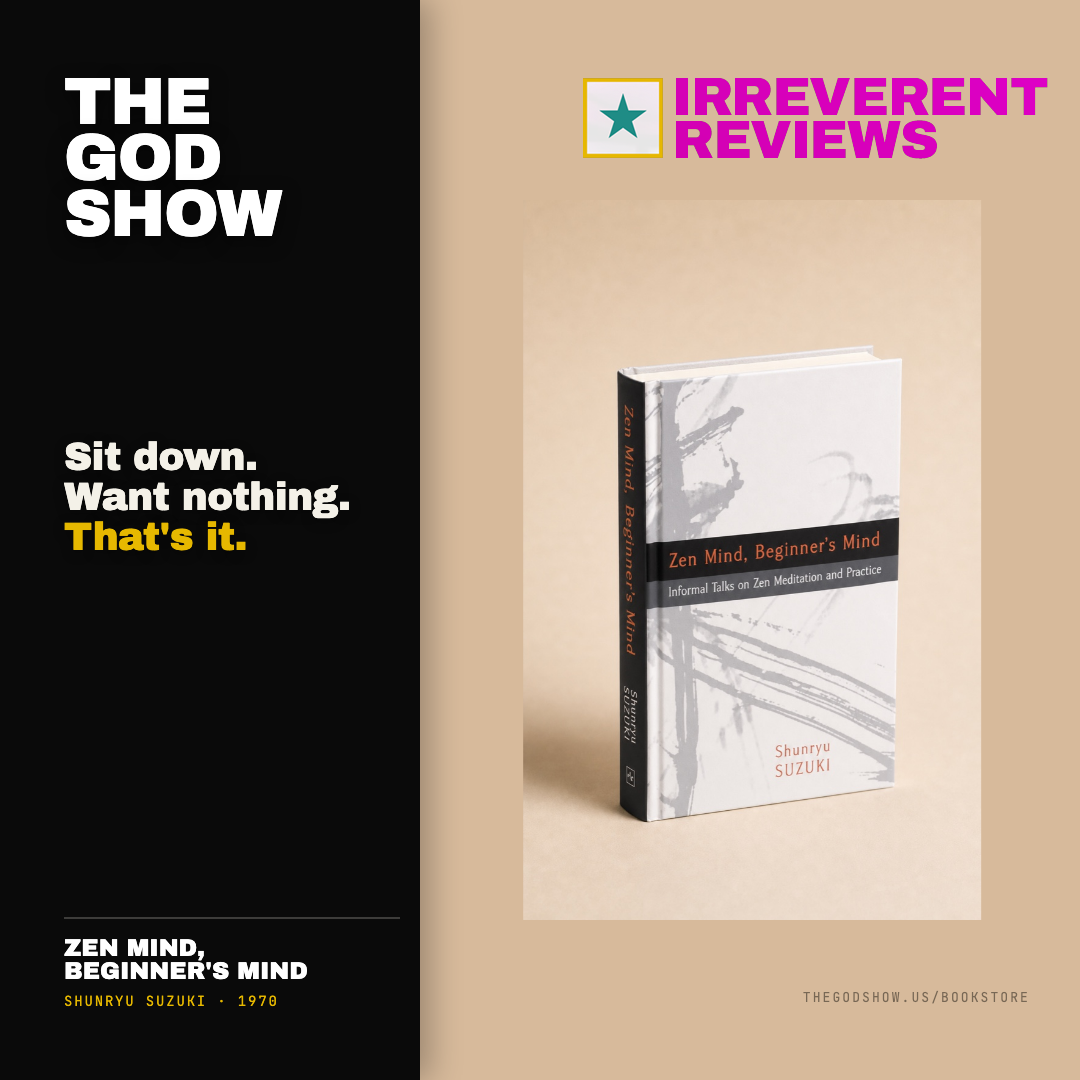
Zen Mind, Beginner's Mind
Shunryu Suzuki · 1970
Dawn-talk transcripts from a tiny Japanese priest in 1960s California became the West's favorite Zen book. Step one: sit down. There is no step two.
Buy on Amazon →In 1959 a small, perpetually amused Soto Zen priest named Shunryu Suzuki flew from Japan to San Francisco to mind a quiet congregation temple—and got ambushed by beatniks who wanted enlightenment, ideally by Friday. His counteroffer: show up before dawn and sit facing a wall. Some did. Afterward he talked—plain, warm, slightly crooked English—somebody ran a tape recorder, and the result became the most beloved Zen book in the West: a complete manual for getting nowhere, lovingly transcribed.
The No-Gaining Racket
The famous opening idea sets the trap: the expert's mind holds a few possibilities, the beginner's holds all of them. From there Suzuki dismantles the entire spiritual economy. Practice is not a technique for acquiring enlightenment; sitting is not the toll you pay for a later prize. The sitting is the whole show—posture itself as realization, breath itself as scripture. He calls the prize-chasing attitude the gaining idea and treats it like a weed. It is a self-help book whose entire message is that there is no self to help and nothing to gain. Enlightenment, in his telling, is nothing special—and the deflation is not a joke. The deflation is the teaching.
Made by Dying Hands
Suzuki never wrote this book. He talked it, at a little sitting group in Los Altos; Marian Derby taped and transcribed the talks, and Trudy Dixon—a young student dying of cancer—shaped them into chapters between hospitalizations. She died in 1969 at thirty; Suzuki, who roared his grief at her funeral, outlived publication by barely a year, gone in 1971. So the calmest book on your shelf was assembled by the dying, on the theme that each breath is already complete. Huston Smith, whose own grand tour of the world's faiths sits elsewhere in this bookstore, supplied the preface. By then Suzuki had also founded Tassajara, the first Zen training monastery outside Asia, in a canyon you still cannot drive into gracefully.
Silicon Valley Buys the Void
The afterlife is the punchline: a book against gaining became a totem of the most acquisitive zip codes on earth. Steve Jobs orbited this exact lineage—his teacher, Kobun Chino, came up through Suzuki's community and later led the very Los Altos zendo where these talks were given—and decades of founders have strip-mined beginner's mind for keynote slides. In 2026, meditation apps award streak badges for non-attainment, which is like selling frequent-flyer miles for staying home. Suzuki would smile, pour tea, and suggest you sit down and lose the badge.
“Every sentence pulls a small chair out from under your ambition.”
Verdict
Read it in an evening; fail to exhaust it in a decade. Every sentence pulls a small chair out from under your ambition. Then it offers the chair back, kindly, and shows you how to sit on it facing a wall. No payoff, no progress bar, no self to upgrade—just this breath, done completely. To the beginner: may your mind stay empty enough to fit everything.