






































Irreverent Reviews
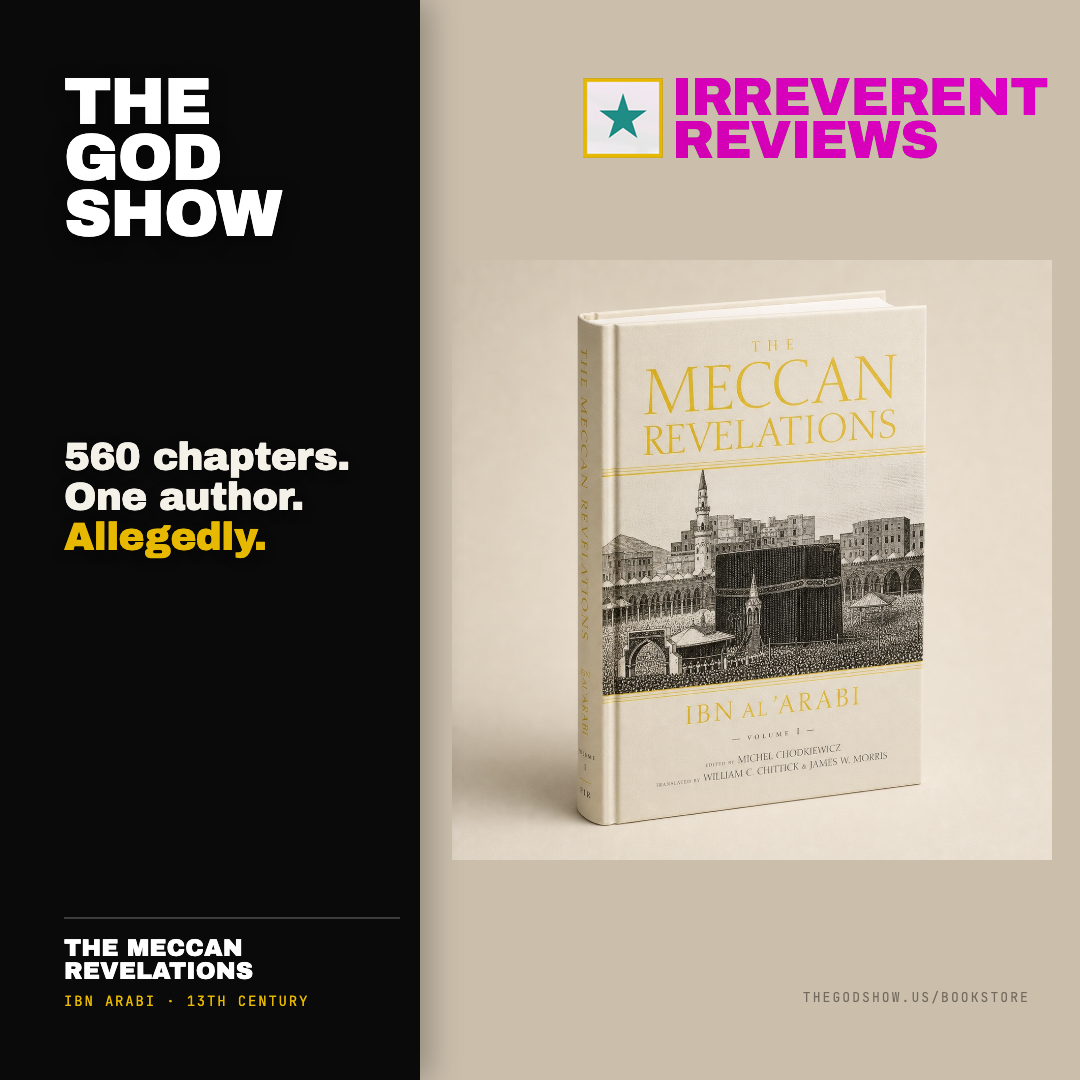
The Meccan Revelations
Ibn Arabi · 13th century
A Sufi master walks into Mecca in 1202, reports that God has started dictating, and does not stop writing for thirty years. Translators still have not caught up.
Buy on Amazon →Most mystics have a moment of union and write a slim volume of ecstatic verse about it. Muhyiddin Ibn Arabi — Andalusian prodigy, professional dreamer, the man later Sufis simply call the Greatest Master — arrived in Mecca in 1202, began circling the Kaaba, and started receiving what he insisted was direct divine dictation. The result, al-Futuhat al-Makkiyya, The Meccan Revelations, runs to 560 chapters across thousands of pages covering cosmology, law, prayer, dreams, the secret lives of letters, and the architecture of every heaven you have heard of plus several you have not. He claimed none of it was his idea. The Meccan Revelations is what happens when a mystic refuses to choose between ecstasy and footnotes.
Divine Dictation, with Revisions
Ibn Arabi was already a legend before the book. As a teenager in Cordoba he was brought to meet Averroes, the greatest rationalist alive, who wanted to test the boy mystic everyone was whispering about; by Ibn Arabi's own delighted account, his answers left the old philosopher shaken. (Yes, he is also the source for that story. Mystics keep excellent receipts on themselves.) The Futuhat consumed three decades. He finished a first version in 1231, then — savor this — produced a second recension, which raises the eternal question of why divinely dictated text needed an editor. His answer would be that revelation unfolds; ours can be that even God's stenographer second-guesses a draft. In 2026, when every influencer claims to be channeling something, remember that Ibn Arabi made the claim in 1202 and backed it with thousands of pages of metaphysics so technical that specialists are still checking the math.
Reality Is God Thinking Out Loud
The core vision, later branded wahdat al-wujud — the unity of being — says there is only one Real, and everything else is that Real disclosing itself, instant by instant, like breath. The cosmos is not furniture; it is a live broadcast, re-created with every exhale of the All-Merciful. You are not a fixed object either: you are a site where the divine names — the Generous, the Avenger, the Subtle — take turns showing off. Most scandalous of all, he argues that the God each person worships is poured into the container of their own belief, which means the wise learn to recognize the Real in every form of devotion. Thirteenth-century readers understood exactly how much dynamite was packed into that idea. Some called him the seal of the saints. Ibn Taymiyya, with characteristic restraint, called it unbelief.
Too Big to Read, Too Hot to Ban
The afterlife is its own comedy. The Ottoman conqueror Selim I took Damascus and built a mosque over Ibn Arabi's tomb; Egypt's parliament was still trying to ban the Futuhat in the 1970s. Eight centuries on there is no complete English translation — only heroic samplers from scholars like William Chittick, who have spent entire careers inside single wings of the building. Scholars do not read the Futuhat. They mount expeditions into it. Some never file a return report.
“Scholars do not read the Futuhat. They mount expeditions into it.”
Verdict
Do not open this expecting a self-help arc; the Futuhat does not improve you, it dissolves the you that wanted improving. It is the most ambitious answer ever drafted to the question of what reality is made of, taken down — allegedly — at the source. Pack water, mark your trail, and raise whatever is left in your canteen to the Greatest Master: an ocean is an unreasonable thing to bottle. He bottled it.