













































Irreverent Reviews
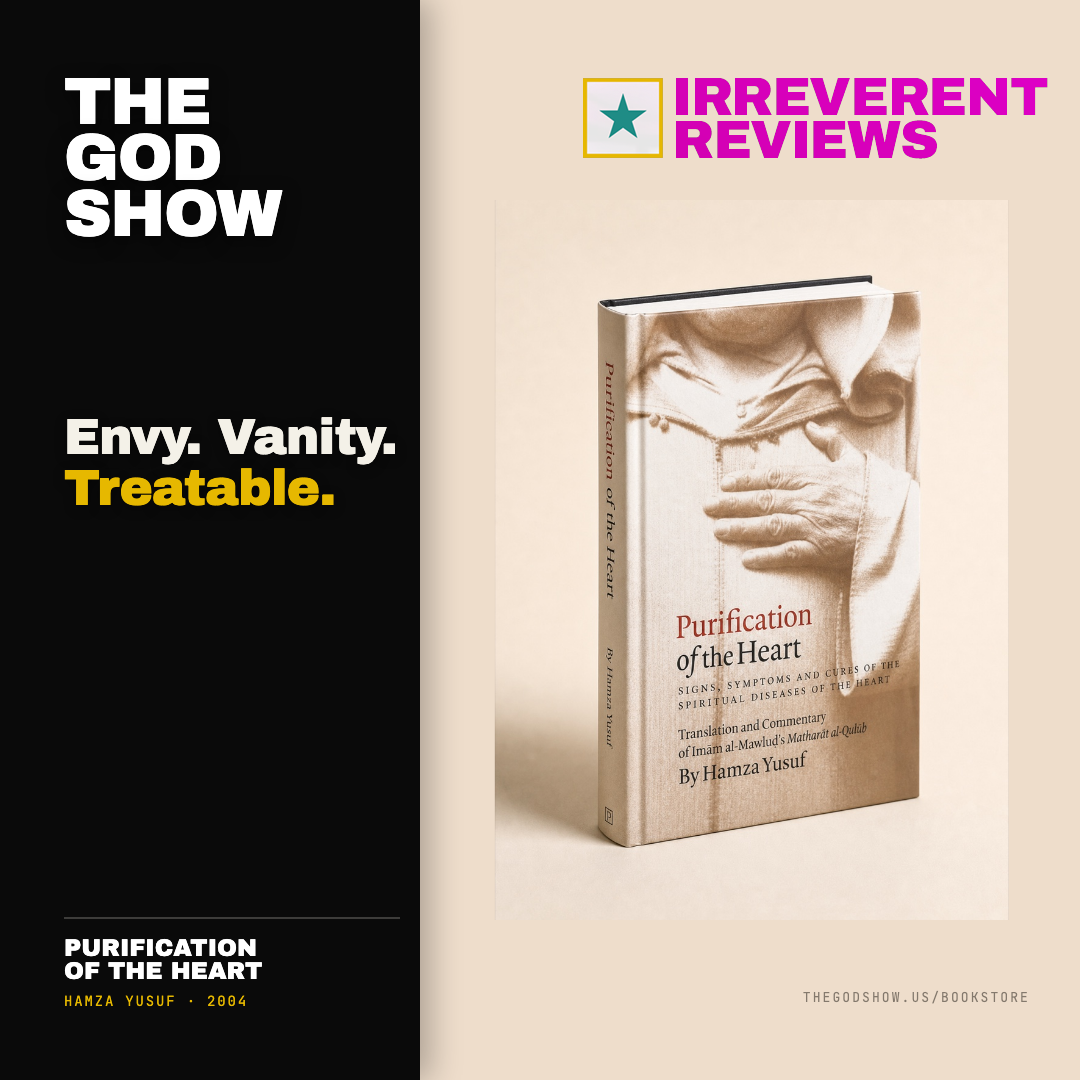
Purification of the Heart
Hamza Yusuf · 2004
A Marin County convert treks into the Sahara, memorizes a 19th-century poem on diseases of the heart, and comes home with a cure for your personality.
Buy on Amazon →Islamic tradition stakes a startling amount on one piece of meat. A celebrated prophetic saying points to a single lump of flesh in the body which, if sound, makes the whole body sound—the heart. In nineteenth-century Mauritania, the scholar Muhammad Mawlud took the claim clinically and versified a complete diagnostic manual: the heart's diseases—envy, ostentation, miserliness, hatred, love of status—each with symptoms, root causes, and cures, set in meter so students could memorize the pharmacy whole. Its courier to America is the genre's least probable figure: Mark Hanson of Marin County, who walked away from a teenage car wreck, converted before twenty, and vanished into the Sahara to study by lamplight in the tent encampment of the ascetic Murabit al-Hajj. He came back as Hamza Yusuf, eventually co-founding Zaytuna College in Berkeley—the first accredited Muslim liberal arts college in the United States—and turning Mawlud's desert poem into this line-by-line commentary.
The DSM of the Soul
The format is pure med school: definition, etiology, treatment plan. Miserliness is traced back to love of this world; envy is distinguished from admiration by a single test—whether you want the blessing shared or destroyed; ostentation is diagnosed as the parasite that eats worship from the inside, since a good deed performed for an audience is really an offering to the audience. It reads less like self-help than a physician's desk reference for the soul. The premise underneath is quietly radical: your worst traits are not your personality. They are acquired infections, and what was acquired can be treated. No chapter lets you sit and admire your wounds. The tradition Mawlud compressed assumes you have agency the way it assumes you have a pulse—and reader discretion is warranted, because the chapter list doubles as a mirror, and the mirror is not flattering.
Wellness, Before the Industry
Yusuf's commentary swings from Quran to Greek ethics to American culture war—charismatic, learned, occasionally cranky; he has spent three decades as American Islam's most celebrated and most second-guessed public scholar, and the lecture-hall heat survives the transcription. But the contrast that lingers is economic. In 2026, the self-improvement industry runs on subscription: keep the patient mildly symptomatic, soothed, and auto-renewing. Mawlud's desert pharmacology has the audacity to aim for discharge. There is no upsell in the poem, no module two, no premium tier—just an austere bet, older and harsher than the entire wellness economy, that envy is not to be managed but killed, and that humility is not a brand voice but a surgical outcome. Therapy asks what happened to you; Mawlud asks, with terrible bedside manner, what you have been doing to everyone else.
“It reads less like self-help than a physician's desk reference for the soul.”
Verdict
You will flinch at least once—the pages on ostentation read minds—and the flinch is the treatment working. Take it slowly, the way its homeland takes tea: in the Sahara they pour three small glasses over a long fire, and the glasses sweeten as the sitting lengthens. First reading bitter, second reading instructive, third reading sweet. To the third glass.