









































Irreverent Reviews
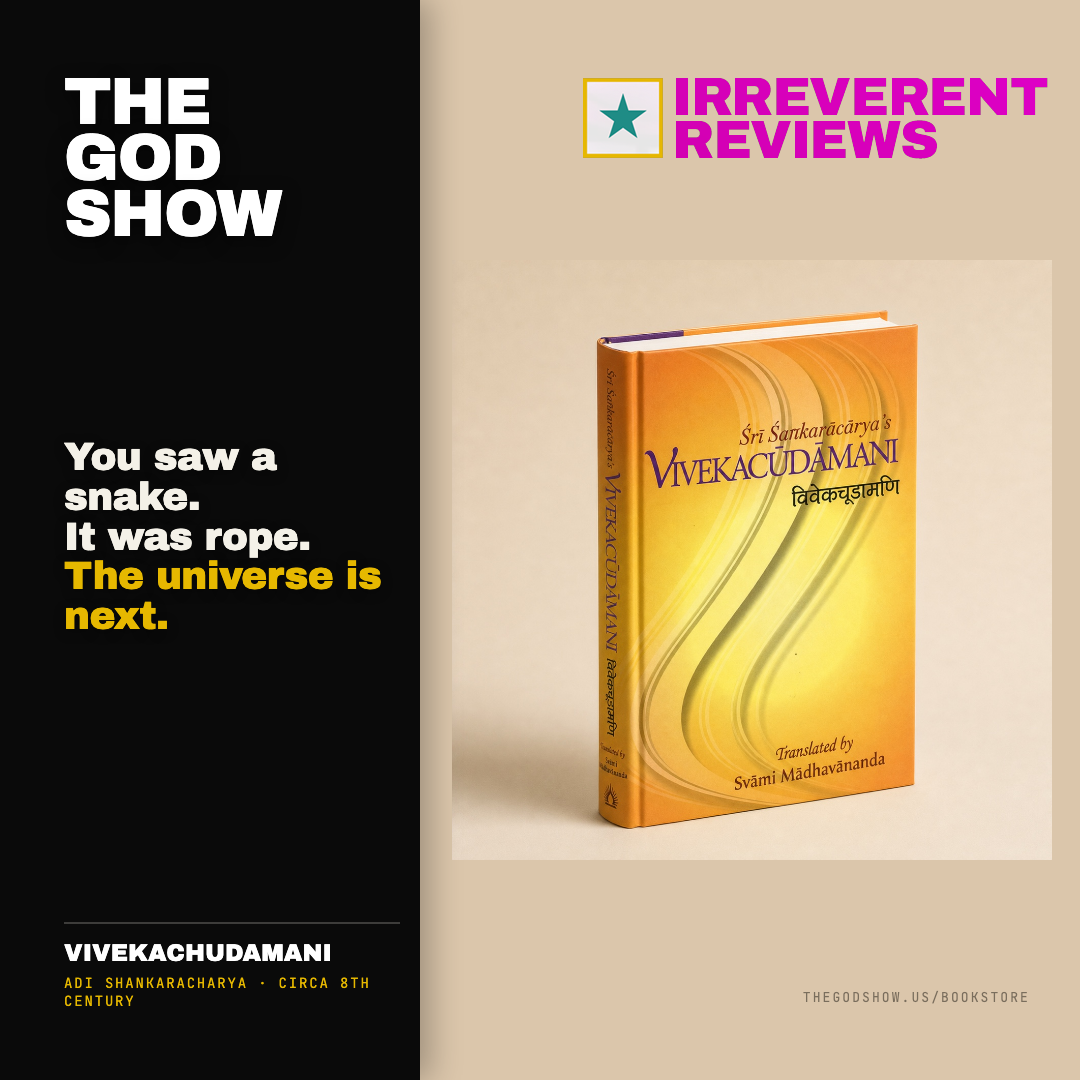
Vivekachudamani
Adi Shankaracharya · Circa 8th century
A medieval monk hands you a crowbar, points at the thing you call 'me,' and starts prying—580 verses on why the reader is the last illusion standing.
Buy on Amazon →Adi Shankaracharya was dead by around thirty-two, and in that time he allegedly walked the length of India on foot, out-argued every philosopher unlucky enough to meet him, reorganized Hindu monasticism into four enduring strongholds, and—tradition says—wrote this, the Crest-Jewel of Discrimination, 580 verses of polished Advaita Vedanta. Scholars now squint at the attribution, which is fitting, because the book's entire thesis is that authorship, biography, and personality are a case of mistaken identity. Shankara is not here to improve you. He is here to file a missing persons report on the 'you' that was never there.
The Snake Was Never There
The text's load-bearing analogy is the rope mistaken for a snake. Dusk, bad light, you jump—then someone brings a lamp, and the serpent was clothesline all along. Advaita's claim is that your entire experienced world runs on this exact glitch at scale: Brahman, the one unchanging reality, misread as a universe of separate objects, separate people, separate you. Viveka—discrimination—is the lamp. The book is a 580-verse training course in telling the real (whatever never changes) from the unreal (literally everything with a timestamp). Your body has a timestamp. Your mind has a timestamp. Draw your own conclusions, slowly, in horror.
Peel the Onion, Lose the Onion
Shankara's method is subtraction. He walks you through the five sheaths—food-body, breath, mind, intellect, even bliss—and disqualifies each one like a bouncer checking IDs. Anything you can observe cannot be the observer. Strip away every layer and what remains is not a smaller, sadder onion; it is the awareness the whole peeling happened in. The Self was never hiding inside the costume. It was the stage lights. In 2026, when your personality is a brand kit with a content calendar, this is the rudest possible news: the product you have been polishing is not just unfinished. It is fictional.
No Refunds, No Rituals
Here is where the monk gets brutal. Pilgrimage won't do it. Ritual won't do it. Scripture recitation, breath control, charity—lovely hobbies, zero liberation. The text is blunt about this: a disease does not leave because you pronounce the word 'medicine'; you have to drink the stuff. Only direct knowledge of what you actually are dissolves the mistake, the way only light dissolves the snake. This was a genuinely radical position in an economy of priests and offerings, and it has aged into a standing rebuke of the entire enlightenment marketplace—no premium tier, no retreat package, no app. The looking is free. The looking is also the one thing nobody wants to do.
“Shankara is not here to improve you. He is here to file a missing persons report on the 'you' that was never there.”
Verdict
The legends around Shankara are deranged in the best way—he allegedly won one debate so decisively that the referee, his opponent's wife, opened a second front and challenged the celibate monk on erotic love, a subject he then researched by methods the hagiographies describe with a perfectly straight face. Take the biography with a salt mine. Take the book straight. The Vivekachudamani is a crowbar applied to the one belief you never thought to audit, swung by a man in a hurry who died young with the job, somehow, finished. Read it slowly anyway. Then raise a glass to the person you thought you were: lovely costume, nobody inside, lights blazing.