

























































Irreverent Reviews
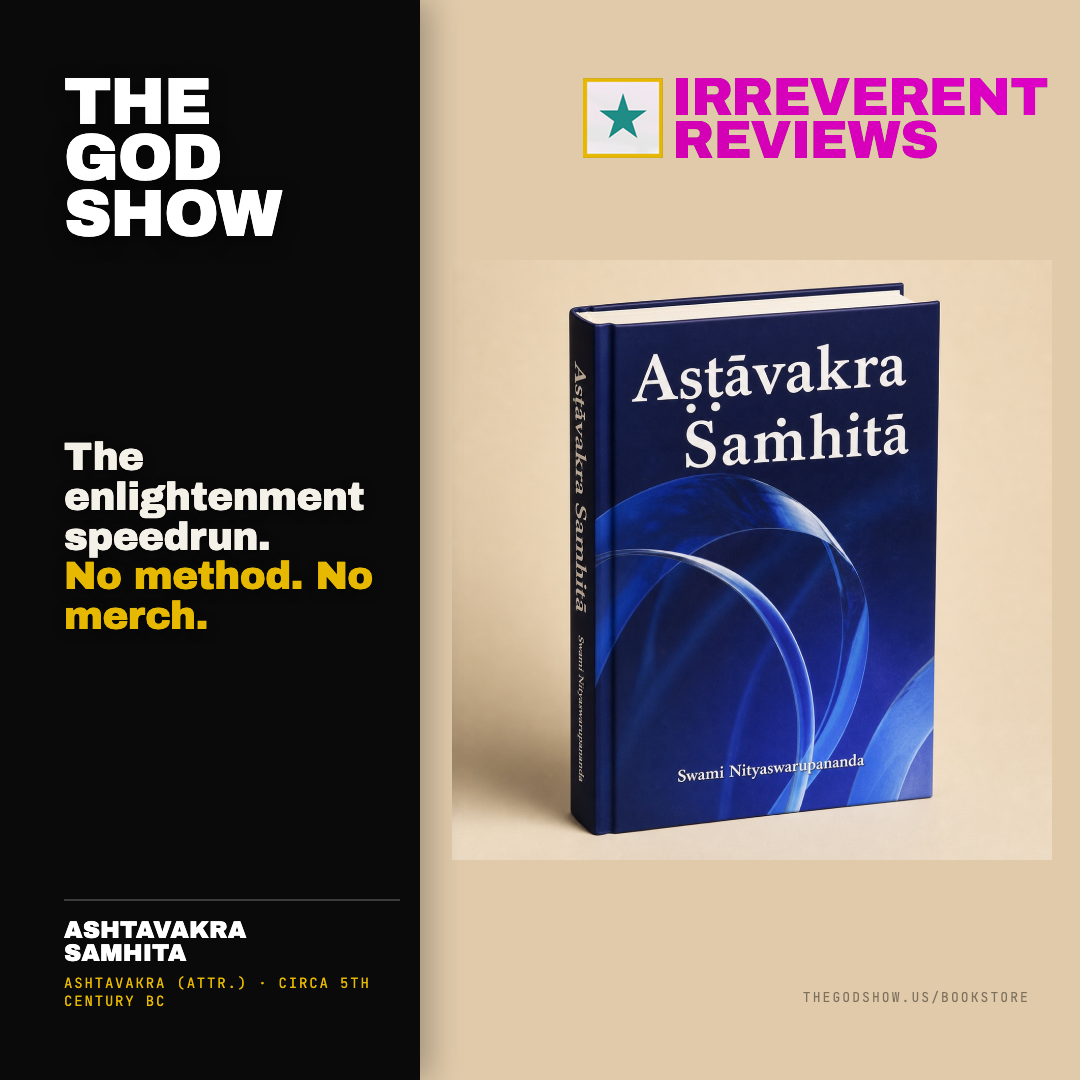
Ashtavakra Samhita
Ashtavakra (attr.) · Circa 5th century BC
A sage bent in eight places limps into court, the scholars laugh, the king listens—and attains liberation so fast the rest of the book is a victory lap.
Buy on Amazon →Somewhere in the deep lore of India there is a sage bent in eight places—cursed from inside the womb, the story goes, for correcting his father's Sanskrit recitation—who limps into the court of King Janaka while the assembled scholars laugh at his body. He informs them they are judging leather, like cobblers, and the king, who can recognize quality arriving in a crooked container, asks the only question worth a throne: how does one become free? What follows is the Ashtavakra Samhita, the most uncompromising document in the nondual canon. No path, no practice, and no patience for your spiritual journey. Nobody knows who wrote it or when; the text would point out that those questions are also chains.
The Roast of King Janaka
Ashtavakra's opening instruction is a controlled demolition. You are not the body, not the elements, not the mind currently panicking about this list. You are the witness—awareness itself—and you are already free; you have merely been impersonating a prisoner. Most scriptures would now assign homework. This one never gets the chance, because Janaka—a sitting king, a man with armies and a calendar—simply gets it. By chapter two he is announcing his own liberation in the tones of a man who found his keys in his pocket. The rest of the book is teacher and student trading escalating descriptions of freedom like two people who cannot stop toasting each other. As an enlightenment speedrun, it has never been beaten.
The Curriculum Is the Cage
Here is the scandal that keeps this text radioactive: Ashtavakra does not just dismiss ritual, he dismisses effort itself. Meditation, austerity, even the noble pursuit of liberation—all of it, on this account, is the rope you keep tying yourself with, because every practice smuggles in the belief that there is a bound someone who needs fixing. The Bhagavad Gita hands Arjuna a job. Ashtavakra hands Janaka a mirror and takes the job away. Teachers in the tradition tended to keep this book on the high shelf, for ripe students only, because in the wrong hands 'you are already free' degrades into a permission slip for doing absolutely nothing with great smugness. They were right to worry. In 2026, the nondual retreat circuit charges four figures a weekend to deliver, slowly and with breathwork, what this book says in the first chapter for free.
“No path, no practice, and no patience for your spiritual journey.”
Verdict
Read it in an afternoon; metabolize it over a decade. The Ashtavakra Samhita is what remains of spirituality after you cancel the curriculum, fire the staff, and bulldoze the gift shop—one bent sage, one ready king, and the bluntest good news ever delivered. It will not give you a practice. It will give you a suspicion, hard to unhear, that the cell door has been open the whole time. To Janaka, then: the only student in history who never needed a second lecture.